
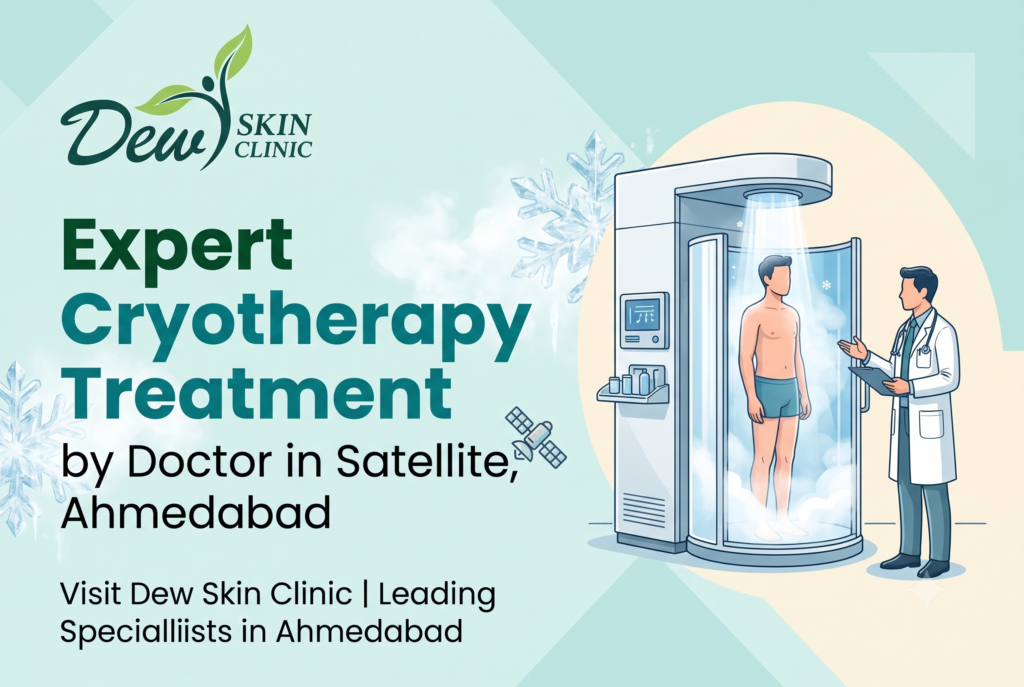
If a wart, skin tag, or stubborn mole on your skin has started bothering you, cryotherapy is usually the fastest way to deal with it. At Dew Skin Clinic, patients in Satellite, Ahmedabad can see an experienced dermatologist for cryotherapy treatment without the long wait times or high fees typical of hospital dermatology departments. This guide explains what cryotherapy is, how the procedure works at our Satellite-area clinic, what it costs, and how to prepare for your first visit.
What Is Cryotherapy Treatment?
Cryotherapy is a dermatology procedure that uses extreme cold, usually liquid nitrogen at around -196°C, to freeze and destroy unwanted or abnormal skin tissue. The cold causes controlled damage to targeted cells, which then die off and are shed by the body over the following one to three weeks, leaving healthy skin behind.
Dermatologists use cryotherapy to treat a wide range of surface-level skin concerns, including:
- Common warts and plantar warts
- Skin tags
- Certain types of moles (after clinical evaluation)
- Actinic keratosis (pre-cancerous sun-damaged patches)
- Seborrheic keratosis
- Molluscum contagiosum
- Some early-stage skin lesions
Because the treatment only affects the targeted area and a thin margin around it, healthy surrounding skin is left largely untouched.
How Cryotherapy Works at Dew Skin Clinic
Every patient who visits our cryotherapy treatment service in Satellite first goes through a short consultation. This step matters more than most people expect, since not every skin growth is a good candidate for freezing, and a dermatologist needs to rule out anything that requires biopsy or a different treatment path.
Once cryotherapy is confirmed as the right approach, the process at our clinic generally follows this sequence:
- Skin examination – the dermatologist inspects the lesion, sometimes using a dermoscope for a closer look.
- Application of liquid nitrogen – using a cotton-tipped applicator or a cryo-spray device, the doctor applies the coolant directly to the lesion for a few seconds at a time.
- Freeze-thaw cycles – depending on the size and depth of the lesion, this freezing step may be repeated two or three times in the same sitting.
- Post-treatment care instructions – the patient is briefed on how the area will look over the next few days and what to do (and avoid) at home.
Most sessions are completed within 10 to 20 minutes, and patients typically walk out the same day without needing downtime.
Cryotherapy has been used in dermatology for decades, and the science behind it is straightforward: when skin cells are cooled rapidly to sub-zero temperatures, ice crystals form inside them, rupturing the cell walls. The body then treats the frozen tissue as damaged, clears it away through normal healing, and replaces it with fresh skin. This is why the technique works well on isolated growths but isn’t used for treating large areas of skin at once.
How Long Has Cryotherapy Been Used, and Is It Considered Safe?
Cryotherapy for skin lesions has been a standard dermatology tool since liquid nitrogen became widely available in clinical settings, and it remains one of the more predictable procedures in outpatient dermatology today. Its safety record comes down to two things: the coolant only affects the tissue it directly touches, and the depth of freezing can be controlled by how long the applicator or spray is held in place. This is very different from home freezing kits sold over the counter, which use a much milder coolant and offer no way to judge how deep the freeze actually goes, or whether the lesion is even a good candidate for freezing in the first place.
Conditions Commonly Treated With Cryotherapy in Satellite
Patients from Satellite and the surrounding Ahmedabad neighborhoods usually come in for one of these specific concerns:
Warts. Viral warts on the hands, feet, or face respond well to cryotherapy, particularly when caught early. Plantar warts on the soles of the feet sometimes need more than one session because the skin there is thicker.
Skin tags. Small, soft growths that form in areas of friction, like the neck, underarms, or eyelids, freeze off quickly and rarely leave a visible mark.
Moles. Not every mole should be frozen. Our dermatologists check the shape, color, and border of any mole before recommending cryotherapy, and refer for biopsy first if anything looks irregular.
Age-related and sun-damage spots. Seborrheic keratosis and actinic keratosis are both common in adults over 40 and are routinely treated with cryotherapy as a first-line option.
Benefits of Choosing a Cryotherapy Doctor in Satellite
Booking a nearby, dermatologist-led clinic instead of a general clinic or an unsupervised aesthetic center has a few practical advantages:
- Accurate diagnosis first. A dermatologist can tell the difference between a harmless skin tag and a lesion that needs further testing, which a generic beauty clinic usually cannot.
- Minimal scarring. Controlled freezing depth, applied by a trained hand, lowers the chance of pigmentation change or scarring compared to do-it-yourself wart removal kits.
- Same-day procedure. Cryotherapy needs no surgical incision, no stitches, and almost no recovery time.
- Local convenience. Patients from Satellite, Vastrapur, Bodakdev, and Prahlad Nagar can reach the clinic without crossing the city, which matters for a treatment that sometimes needs a follow-up session.
- Affordable pricing. Compared to laser removal or minor surgery, cryotherapy is one of the more budget-friendly options for the same category of skin growths.
How to Choose the Right Cryotherapy Doctor in Satellite
Not every clinic offering cryotherapy is staffed by a dermatologist, and that distinction matters more than most patients realize. A few questions are worth asking before booking anywhere:
- Is the procedure performed by a qualified dermatologist, or by a technician following a script? A dermatologist can catch warning signs, like irregular pigmentation or asymmetry, that a non-specialist might miss entirely.
- Does the clinic examine the lesion before quoting a price? If a clinic quotes a flat fee over the phone without seeing the growth, that’s a sign the diagnostic step is being skipped.
- What happens if the lesion looks suspicious? A proper clinic should be able to order a biopsy or refer you onward, rather than freezing anything and everything that walks through the door.
- Is aftercare guidance given clearly, in writing if needed? Good aftercare instructions reduce the risk of infection and scarring far more than the freezing technique itself does.
- Can the clinic show real patient outcomes? Reviews and before-after context, like those on our testimonials page, give a more honest picture than marketing copy alone.
For patients in Satellite specifically, proximity also matters. Cryotherapy sometimes needs a follow-up freeze two to three weeks later, and a clinic that’s a long drive away makes that second visit more likely to get postponed or skipped.
What to Expect During Your Cryotherapy Session
Patients often ask what the freezing actually feels like and how the skin behaves afterward. Here is a realistic walk-through of the experience:
During the procedure: Most patients describe a stinging or burning sensation while the liquid nitrogen is applied, lasting only a few seconds per freeze cycle. Numbing cream is rarely needed for small lesions, though the dermatologist may use it for sensitive areas or larger growths.
Right after treatment: The treated spot usually turns white, then red, within a few minutes. Mild swelling is common, especially on the face.
Within 24-48 hours: A blister often forms over the treated area. This is a normal part of healing, not a complication, and it should be left alone rather than popped.
Over 1-3 weeks: The blister dries into a scab, which flakes off naturally as new skin forms underneath.
Follow-up visit: For warts or thicker lesions, the dermatologist may schedule a second freezing session two to three weeks later if the growth hasn’t fully resolved.
Cryotherapy Cost in Satellite, Ahmedabad
Cryotherapy pricing depends on the number, size, and type of lesions being treated, as well as how many sessions are required. Consultation and exact pricing are confirmed during your visit, since a dermatologist needs to physically assess the growth before quoting a final cost. As a general pattern across Ahmedabad clinics, single small lesions (like one skin tag or wart) cost less than treating multiple growths in one sitting, and clinics led by qualified dermatologists price sessions based on both the procedure and the diagnostic time involved. For an accurate quote specific to your case, book a consultation at our Satellite-area clinic.
Why Choose Dew Skin Clinic in Satellite for Cryotherapy
Dew Skin Clinic has built its popular treatments list around procedures that are quick, evidence-based, and performed by qualified dermatologists rather than technicians. A few things set the clinic apart for patients specifically searching for a cryotherapy doctor near Satellite:
- Dermatologist-led diagnosis, not a walk-in freeze-and-go service. Our team, including Dr. Vishal H. Shroff, reviews each lesion before treatment is recommended.
- Modern equipment for controlled, even freezing that reduces the risk of over-treating healthy skin.
- Transparent aftercare guidance, given verbally and in writing, so patients know exactly what to expect at home.
- A full range of complementary services on-site, including dermoscopy for closer lesion evaluation and skin biopsy when a growth needs lab confirmation before any procedure.
- Easy access from Satellite, with the clinic serving patients across Vaishno Devi Circle, Chandkheda, Motera, Adalaj, and Jagatpur as well.
Patient reviews on the clinic’s testimonials page reflect this focus on careful, dermatologist-supervised care rather than rushed, high-volume appointments.
Cryotherapy vs Other Removal Methods
| Method | Downtime | Scarring Risk | Typical Sessions | Best For |
|---|---|---|---|---|
| Cryotherapy | None to minimal | Low | 1-3 | Warts, skin tags, small keratosis |
| Electrocautery | Minimal | Moderate | 1 | Larger skin tags, some moles |
| Surgical excision | A few days | Higher (stitches) | 1 | Deeper or larger lesions |
| Laser removal | Minimal | Low to moderate | 1-2 | Precise, cosmetic-sensitive areas |
Cryotherapy tends to be the first choice for small, surface-level growths because it needs no cutting and heals with the least visible mark. For lesions that are deeper, unusually large, or suspicious in appearance, a dermatologist may instead recommend CO2 laser and electrocautery treatment or refer the patient for a proper skin biopsy first.
Aftercare Tips Following Cryotherapy
Healing well after cryotherapy is mostly about leaving the area alone. Our dermatologists generally recommend:
- Keep the treated spot clean and dry for the first 24 hours.
- Avoid picking at the blister or scab, even when it starts to itch.
- Apply a plain antiseptic ointment if advised by your dermatologist, not a random over-the-counter cream.
- Use sunscreen on the treated area once it has healed, since new skin is more sensitive to UV exposure.
- Skip swimming pools or steam rooms until the scab has fully come off.
- Watch for signs of infection, such as increasing redness, pus, or fever, and contact the clinic if any of these appear.
Mild discomfort for a day or two is expected. Anything beyond that, especially spreading redness or persistent pain, should be checked by the treating dermatologist rather than waited out.
Who Should Avoid Cryotherapy
Cryotherapy is not suitable for everyone. A dermatologist will usually advise against it, or proceed with extra caution, for:
- Patients with poor circulation or conditions like Raynaud’s disease
- Very dark skin tones in cosmetically sensitive areas, due to a higher risk of pigmentation changes
- Pregnant patients, for certain lesion types and locations
- Anyone with an active skin infection at the treatment site
- Lesions that look clinically suspicious and need biopsy before any destructive treatment
This is exactly why a proper consultation matters more than a same-day freeze at an uncertified center. Skipping the diagnostic step can mean missing something that needed a different kind of attention entirely.
Other Skin & Hair Treatments Available Near Satellite
Patients visiting for cryotherapy often ask about other concerns during the same trip. Dew Skin Clinic’s Satellite-area services also include:
- Trusted dermatology clinic in Satellite for general skin consultations
- GFC hair treatment in Satellite for hair thinning and hair loss
- Hair loss treatment near Satellite
- Acne scar treatment near Satellite
- Anti-aging skin treatment near Satellite
Frequently Asked Questions
Is cryotherapy painful?
Most patients feel a brief stinging or burning sensation during the freeze, lasting only a few seconds per cycle. It’s generally more tolerable than surgical removal and needs no anesthesia for small lesions.
How many sessions does cryotherapy usually take?
Small, thin lesions often clear in a single session. Thicker warts or larger growths may need two to three sessions spaced a few weeks apart.
Does cryotherapy leave a scar?
When performed correctly by a trained dermatologist, scarring is uncommon. Some patients notice temporary lightening or darkening of the treated skin, which usually fades over a few months.
Can cryotherapy remove moles?
Some moles can be treated with cryotherapy, but only after a dermatologist examines the shape, color, and borders. Irregular or suspicious moles are referred for biopsy instead of being frozen.
How long does recovery take after cryotherapy?
Most patients return to normal activity the same day. The treated area typically blisters within a day or two and fully heals, with the scab flaking off, within one to three weeks.
Is cryotherapy safe for children?
Yes, in many cases, particularly for common warts, though a dermatologist will assess the child’s skin and tolerance before proceeding.
How much does cryotherapy cost in Ahmedabad?
Cost depends on the size, number, and type of lesions treated. A dermatologist can only give an accurate quote after a physical examination during your consultation.
Will the wart or skin tag come back after cryotherapy?
Skin tags rarely return once fully removed. Viral warts can occasionally recur or appear elsewhere, since the underlying virus may still be present in the skin, which is why some patients are advised to monitor the area for a few months after treatment.
Do I need to stop any skincare products before my appointment?
Generally no special preparation is needed for cryotherapy, though it helps to avoid applying heavy creams or makeup directly over the lesion on the day of your visit so the dermatologist has a clear view of the area.
Book Your Cryotherapy Consultation in Satellite, Ahmedabad
If you’ve been living with a wart, skin tag, or an unusual mole and want it looked at by a qualified dermatologist rather than guessing at a home remedy, Dew Skin Clinic’s team in the Satellite area is set up for exactly this. Every case starts with a proper examination, not an assumption, and treatment is planned around what’s actually on your skin. Book an appointment or visit the contact page to speak with the clinic directly and get a cryotherapy consultation scheduled.