
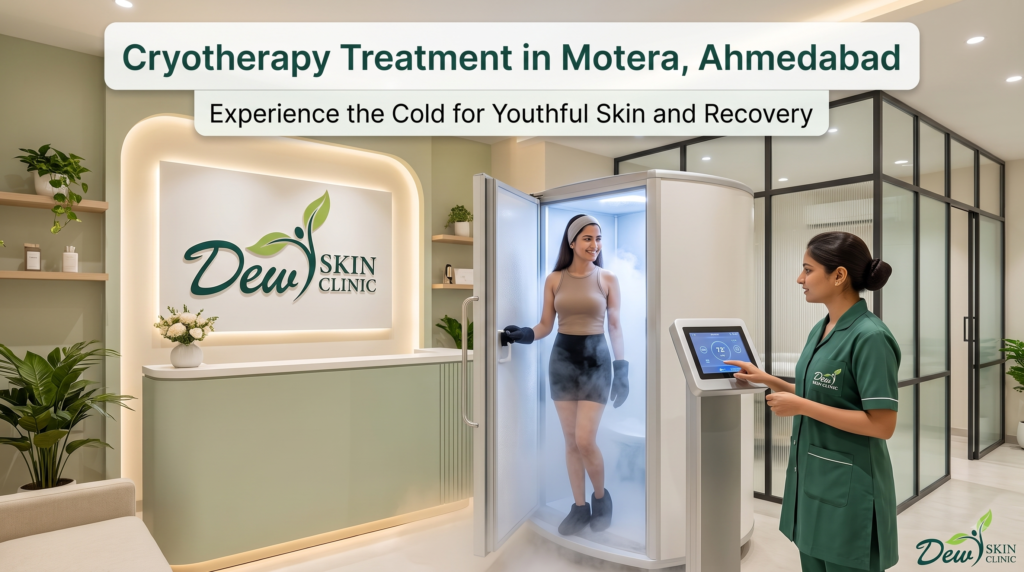
Cryotherapy Treatment in Motera, Ahmedabad: Complete Guide by Dew Skin Clinic
If you live in Motera and you have been struggling with a stubborn skin tag, a wart that will not go away, an unsightly mole, or an early skin growth that your dermatologist has flagged for removal, cryotherapy treatment in Motera Ahmedabad could be the fastest, safest, and most affordable way to deal with it. At Dew Skin Clinic, we perform image-guided cryotherapy for a wide range of skin conditions using medical-grade liquid nitrogen, under the direct supervision of qualified dermatologists.
This guide walks you through everything a Motera resident needs to know before booking a cryotherapy treatment — what it is, which conditions it treats, how the procedure feels, recovery timelines, cost factors, and why patients across Chandkheda, Sabarmati, and Motera choose our clinic for freezing-based skin procedures.
What Is Cryotherapy Treatment?
Cryotherapy — also called cryosurgery or cryoablation — is a dermatological procedure that uses extremely cold temperatures, most commonly liquid nitrogen at around -196°C, to freeze and destroy abnormal or unwanted skin tissue. The extreme cold causes controlled damage to the targeted cells, which then die off and are naturally shed by the body over the following one to three weeks.
Because the freezing is applied with precision, healthy surrounding skin is left largely untouched, making cryotherapy one of the least invasive options for removing surface-level skin growths. No cutting, no stitches, and in most cases, no general anaesthesia is required.
At Dew Skin Clinic, cryotherapy is performed by trained dermatologists as part of our broader clinical dermatology services, ensuring every session is medically assessed before treatment begins — never a walk-in, no-questions-asked freeze.
How Does Cryotherapy Work on the Skin?
When liquid nitrogen contacts the skin, ice crystals form inside and around the targeted cells. This process ruptures the cell membrane and cuts off blood supply to the tissue (a process called thrombosis), which causes the abnormal cells to die. Over the next few days, the treated area typically blisters, scabs, and eventually flakes off, revealing new, healthy skin underneath.
The Science: Why Freeze-Thaw Cycles Matter
Dermatologists rarely apply liquid nitrogen just once. Most protocols use two to three freeze-thaw cycles per lesion — freezing the tissue, allowing it to thaw naturally, then freezing again. Research in dermatologic surgery has shown that repeated freeze-thaw cycles cause deeper and more complete cell destruction than a single prolonged freeze, which is why your dermatologist may apply the nitrogen in short, repeated bursts rather than one long application. This is also why session length can vary — a single flat wart might take 10-15 seconds per cycle, while a thicker plantar wart may need longer, more repeated applications.
Skin Conditions Cryotherapy Treats
Cryotherapy is a versatile, targeted treatment. Our Motera-area patients most commonly come in for the following concerns:
- Warts and verrucas — including common hand warts, plantar warts, and flat warts that have not responded to over-the-counter treatments
- Skin tags — small, soft growths commonly found on the neck, underarms, and eyelids
- Moles — benign moles that are cosmetically bothersome or have been medically cleared for removal
- Birthmarks — select superficial birthmarks suitable for freezing-based reduction
- Actinic keratosis — rough, scaly, sun-damage patches considered precancerous
- Seborrheic keratosis — raised, waxy, brown or black growths common with age
- Molluscum contagiosum — small viral skin bumps, especially common in children
- Corns and calluses on pressure points of the feet
- Dermatofibromas — small, firm nodules that sometimes form after minor skin trauma
- Keloid and hypertrophic scar tissue — in select cases, used alongside other keloid-reduction protocols
If you are unsure whether your specific skin growth is a good candidate for freezing, our dermatologists will examine it during consultation and may use dermoscopy to confirm before recommending cryotherapy over an alternative approach.
Key Benefits of Choosing Cryotherapy Over Other Removal Methods
Patients often ask why a dermatologist would recommend freezing over surgical excision, laser removal, or electrocautery. Cryotherapy has a distinct set of advantages that make it the first-line choice for many superficial skin lesions:
- No cutting or stitches — the treated tissue sloughs off naturally over one to three weeks
- Typically completed in a single short visit, often under 15 minutes per lesion
- Minimal to no downtime — most patients return to work or daily errands the same day
- Lower infection risk compared to surgical excision, since the skin barrier is not cut open
- Cost-effective compared to laser-based removal for small, superficial lesions
- Can be repeated safely if a lesion needs a second round of treatment
- No general anaesthesia required for the vast majority of cases
For deeper or more complex growths, our dermatologists may instead recommend CO2 laser and electrocautery treatment — the choice between methods always comes down to the size, depth, and location of the lesion, which is why an in-person assessment matters more than self-diagnosing from photos online.
Cryotherapy vs. Surgical Excision vs. Laser Removal
| Factor | Cryotherapy | Surgical Excision | Laser Removal |
|---|---|---|---|
| Downtime | Minimal, same-day recovery | A few days to a week | Minimal to moderate |
| Anaesthesia | Usually not needed | Local anaesthesia required | Topical numbing usually used |
| Best for | Small, superficial, benign lesions | Larger or suspicious lesions needing biopsy | Pigmented or vascular lesions |
| Scarring risk | Low | Moderate (stitches involved) | Low to moderate |
| Typical cost | Lower | Higher | Higher |
| Sessions needed | 1-3 | Usually 1 | Often 1-3 |
Surgical excision is generally reserved for larger or suspicious lesions that require a tissue sample to be sent for biopsy. Laser removal offers more precision for pigmented or vascular lesions but usually costs more per session. Cryotherapy sits in the middle as the fastest, most economical option for benign, superficial growths — which is why it remains one of the most commonly performed in-clinic removal procedures for warts, skin tags, and similar lesions across Ahmedabad dermatology clinics, including ours.
Why Motera Residents Choose Cryotherapy Near Them
Motera has grown rapidly over the past few years — from the area around the world’s largest cricket stadium to the residential pockets stretching toward Sabarmati and Chandkheda — and with that growth has come demand for reliable, close-to-home dermatology care. Patients in Motera no longer want to cross the city to Satellite or Prahlad Nagar for a 10-15 minute freezing procedure.
Dew Skin Clinic serves patients across the northwestern Ahmedabad corridor, and our cryotherapy treatment in Chandkheda location is a short drive from Motera, making it convenient for residents near the stadium, GIFT City approach road, and New Ranip to get in, get treated, and get back to their day.
Because cryotherapy sessions are quick — most single-site treatments take under 15 minutes — many of our Motera patients book an early morning or lunch-hour slot and are back at work the same day.
Serving Motera’s Growing Community
Motera has transformed from a quiet suburb into one of Ahmedabad’s fastest-developing residential and commercial corridors, driven largely by the area around the Narendra Modi Stadium and its improving connectivity to SG Highway, Sabarmati, and the GIFT City corridor. With that growth has come a younger, increasingly health-conscious population that wants dermatology care close to home rather than a 40-minute drive across the city.
For many Motera residents, a small skin tag or a wart on the hand is a low priority until it becomes bothersome — catching on jewellery, irritated by daily shaving, or simply an ongoing cosmetic concern. Because cryotherapy sessions are so quick, it is realistic to fit a consultation and treatment into a lunch break or before/after work, without needing to plan an entire afternoon around it.
Our team frequently sees patients from Motera alongside those from Chandkheda and near Vaishno Devi Circle, reflecting how central our clinic location is for the entire northwestern Ahmedabad belt.
What Happens During a Cryotherapy Appointment
Knowing what to expect makes the procedure far less intimidating. Here is how a typical cryotherapy visit unfolds at our clinic:
Step 1: Consultation and Skin Assessment
Every cryotherapy patient first meets with a dermatologist. We examine the growth, confirm it is a suitable candidate for freezing (rather than surgical excision or laser), and explain the expected number of sessions. If there is any doubt about whether a growth is benign, dermoscopy or a referral for biopsy is recommended before treatment.
Step 2: Preparing the Area
The treatment site is cleaned. For sensitive areas or larger lesions, a topical numbing cream may be applied 20-30 minutes beforehand, though most small warts and skin tags do not require anaesthesia.
Step 3: Application of Liquid Nitrogen
Using a cryogun or a cotton-tip applicator, the dermatologist applies liquid nitrogen directly to the lesion for a few seconds at a time, allowing the area to freeze and thaw — sometimes repeated in two or three freeze-thaw cycles depending on the size and depth of the growth. A visible white “ice ball” typically forms around the treated tissue, which the dermatologist monitors to judge depth and margin.
Step 4: Immediate Aftercare Instructions
You will notice redness and mild stinging immediately after treatment — this is normal. Our team walks you through home care before you leave, and you can resume most normal activities right away.
Step 5: Follow-Up Planning
Before you leave, we schedule a follow-up if a second freeze cycle is anticipated, and flag any warning signs (excessive swelling, pus, or fever) that should prompt an earlier check-in.
Cryotherapy Recovery Timeline: What to Expect Day by Day
- Day 0-1: Redness, mild swelling, and a stinging or burning sensation at the site
- Day 1-3: A blister may form — this is a normal part of the healing response and should not be popped
- Day 3-7: The blister dries out and a scab forms over the treated area
- Day 7-21: The scab naturally flakes off, revealing new skin underneath
- Week 3-6: Any residual pink or light discoloration typically fades, though this can take longer on darker skin tones
Deeper lesions such as larger warts or seborrheic keratoses sometimes need a second or third session, spaced two to four weeks apart, for complete clearance.
Aftercare Tips for Faster, Cleaner Healing
- Keep the area clean and dry for the first 24 hours
- Apply a thin layer of antibiotic ointment if advised by your dermatologist
- Avoid picking at the blister or scab — let it fall off naturally to reduce scarring risk
- Use sunscreen on the treated area once it has healed to prevent pigmentation
- Avoid swimming pools and prolonged water exposure until the scab has fully healed
- Wear loose clothing over treated areas on the body to reduce friction
Do’s and Don’ts After Cryotherapy
| Do | Don’t |
|---|---|
| Keep the area clean and dry | Pop or peel the blister |
| Apply prescribed ointment as directed | Apply harsh soaps, scrubs, or exfoliants |
| Use sunscreen once healed | Expose the fresh scab to direct sun |
| Watch for signs of infection | Ignore fever, pus, or spreading redness |
| Attend your follow-up if a second session is planned | Self-treat with home remedies mid-healing |
Patients who are also managing broader skin concerns often pair their recovery routine with our IV skin wellness drips or a follow-up medi-facial treatment once the treated area has fully healed, to support overall skin recovery.
Cryotherapy Treatment Cost in Ahmedabad: What Affects the Price
Cryotherapy is one of the more affordable dermatological procedures precisely because it is quick and does not require an operating theatre. That said, the exact cost depends on several factors:
- Number and size of lesions being treated in a single visit
- Location on the body (facial lesions near the eyes require more precision and time)
- Depth of the growth and number of freeze-thaw cycles required
- Whether one session is sufficient or multiple sessions are needed
- Whether a biopsy or dermoscopy assessment is required beforehand
For an accurate, personalised quote, we recommend booking a consultation through our book appointment page, where our team will assess your specific skin concern and share transparent pricing before any treatment begins.
Is Cryotherapy Safe? Risks and Who Should Avoid It
Cryotherapy has an excellent safety profile when performed by a trained dermatologist, but like any medical procedure it carries some risks, including:
- Temporary redness, swelling, and blistering
- Mild pain or a burning sensation during and shortly after treatment
- Rare risk of scarring, particularly with deeper or repeated treatments
- Temporary or, in rare cases, permanent lightening or darkening of the treated skin — a higher consideration for melanin-rich skin
- Nerve sensitivity in areas treated near fingers or toes
- Rare risk of infection if aftercare instructions are not followed
Cryotherapy is generally not recommended for patients with cold sensitivity disorders such as cryoglobulinemia, Raynaud’s disease, or certain autoimmune conditions. Pregnant patients and those with active skin infections in the treatment area should also consult a dermatologist before proceeding. This is precisely why every cryotherapy session at Dew Skin Clinic begins with a proper medical evaluation rather than a same-day walk-in freeze.
Who Is a Good Candidate for Cryotherapy Treatment?
Not every skin growth should be frozen without evaluation, and not every patient is an ideal candidate. Generally, you may be a good fit for cryotherapy if:
- You have a benign, superficial skin lesion such as a wart, skin tag, or common mole
- Your dermatologist has examined and confirmed the growth does not require a biopsy first
- You do not have a cold-sensitivity disorder or an active infection at the treatment site
- You are looking for a quick, minimally invasive option with limited downtime
If a growth has changed shape, color, or size rapidly, is bleeding, or looks irregular, our dermatologists will first assess it clinically — and may recommend a skin biopsy — rather than proceeding straight to cryotherapy. Skin cancer screening is always part of a thorough evaluation for any new or changing growth.
Common Myths About Cryotherapy — Debunked
Myth: Cryotherapy always leaves a scar. Fact: When performed correctly on suitable lesions, scarring risk is low. Scarring is more associated with deep, repeated freezes or lesions that were not good candidates to begin with.
Myth: You can do cryotherapy at home with over-the-counter wart-freeze kits and get the same results. Fact: Over-the-counter kits use a much milder refrigerant than medical-grade liquid nitrogen and cannot achieve the same depth of freeze, which is why home treatments often fail on anything beyond very small, shallow warts.
Myth: One session is always enough. Fact: Many lesions, especially thicker warts, need two to three sessions spaced a few weeks apart for full clearance.
Myth: Cryotherapy is only for warts. Fact: While warts are common, cryotherapy also treats skin tags, moles, seborrheic keratosis, molluscum contagiosum, and more, as outlined earlier in this guide.
Why Choose Dew Skin Clinic for Cryotherapy in Motera, Ahmedabad
- Dermatologist-led assessment before every cryotherapy session — never a technician-only procedure
- Medical-grade liquid nitrogen equipment maintained to clinical safety standards
- Precise, controlled application designed to protect surrounding healthy skin
- Convenient proximity for patients across Motera, Sabarmati, New Ranip, and Chandkheda
- Transparent pricing with no hidden session charges
- A full range of complementary dermatology services under one roof
Our dermatology team also manages related concerns such as acne scars, pigmentation and melasma, and hair loss and thinning, so if cryotherapy uncovers or coincides with another skin or hair concern, you do not need to be referred elsewhere.
You can read more about our dermatologists and clinical approach on our About Us page, or browse our complete list of services to see how cryotherapy fits into a broader skin-health plan.
Cryotherapy Treatment Near Motera: Other Areas We Serve
Beyond Motera, Dew Skin Clinic is a trusted choice for patients travelling in from nearby neighbourhoods for cryotherapy and related dermatology treatments:
- Cryotherapy treatment in Chandkheda
- Dermatology clinic near Sindhu Bhavan Road
- Hair loss treatment in Motera
- Anti-aging skin treatment in Motera
- GFC hair treatment near Vaishno Devi Circle
- Trusted dermatology clinic in Chandkheda
Frequently Asked Questions About Cryotherapy in Motera, Ahmedabad
1. Is cryotherapy painful?
Most patients describe a stinging or burning sensation during application that subsides within a few minutes. Larger or deeper lesions may require numbing cream beforehand.
2. How many sessions of cryotherapy will I need?
Small, superficial growths like flat warts or tiny skin tags often clear in a single session. Larger or deeper lesions such as plantar warts may need two to three sessions spaced a few weeks apart.
3. Does cryotherapy leave a scar?
When performed correctly by a trained dermatologist, scarring risk is low. Deeper or repeated freezes on the same site carry a slightly higher risk, which your dermatologist will factor into your treatment plan.
4. Can cryotherapy be used on the face?
Yes, cryotherapy is commonly used on facial skin tags, moles, and seborrheic keratosis, though extra precision is used near the eyes, lips, and nose.
5. How soon can I resume normal activities after treatment?
Most patients return to normal daily activities immediately. Strenuous exercise, swimming, and sun exposure on the treated area are usually best avoided for a few days.
6. Is cryotherapy suitable for children?
Yes, cryotherapy is commonly used to treat molluscum contagiosum and warts in children, though a dermatologist will assess comfort and cooperation levels before recommending it over gentler alternatives.
7. What is the difference between cryotherapy and cryofacial treatments?
Medical cryotherapy (covered in this guide) targets specific lesions like warts and skin tags using liquid nitrogen for tissue destruction. Cryofacials are a separate cosmetic treatment that uses cooled air across the whole face to reduce puffiness and boost glow — the two should not be confused when researching treatments online.
8. How do I book a cryotherapy appointment near Motera?
You can book directly through our appointment page or reach out via our contact us page, and our team will help you find the earliest available slot.
Book Your Cryotherapy Consultation at Dew Skin Clinic
Whether it is a wart that has lingered for months, a skin tag catching on your clothing, or a mole your dermatologist has recommended removing, cryotherapy treatment offers a fast, minimally invasive, and clinically proven solution. Patients across Motera, Chandkheda, and the surrounding Ahmedabad neighbourhoods trust Dew Skin Clinic for dermatologist-led cryotherapy performed with medical-grade precision. Explore our full range of clinical dermatology services or book an appointment today to get your skin concern assessed by our expert team.