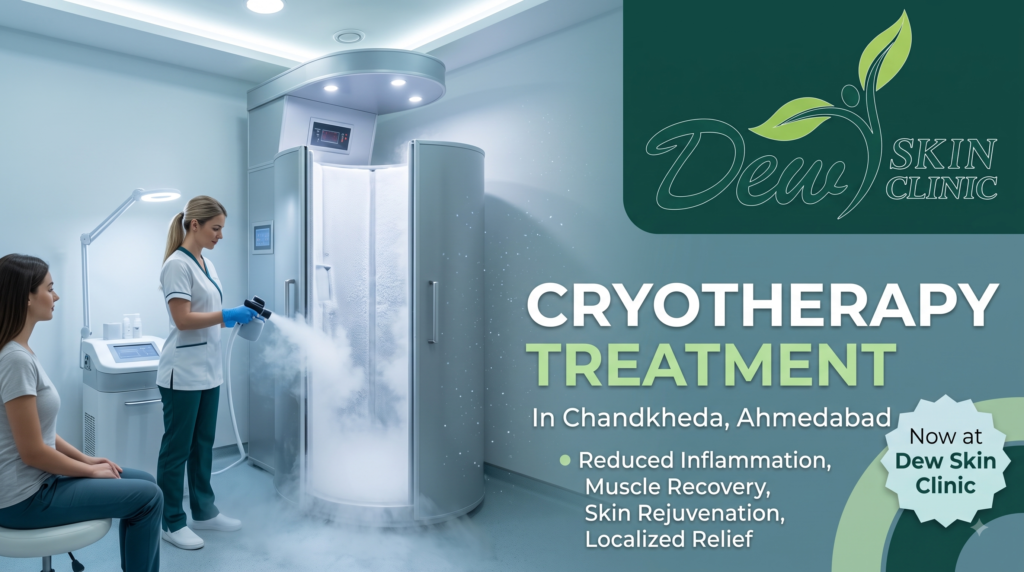
Chandkheda has grown into one of Ahmedabad’s busiest residential pockets, and with that growth has come a steady rise in people looking for quick, reliable answers to everyday skin problems. Warts that won’t go away, a stubborn skin tag near the collar line, a mole that suddenly changed shape — these are the kind of concerns patients bring to Dew Skin Clinic every week. Cryotherapy treatment in Chandkheda, Ahmedabad has become one of the most requested procedures at our clinic precisely because it solves these problems without surgery, stitches, or long downtime. This guide walks through what cryotherapy actually is, which conditions it treats, what the procedure feels like, and why patients across Chandkheda, Motera, Sabarmati and nearby areas choose Dew Skin Clinic for it.
What Is Cryotherapy and How It Works
Cryotherapy, sometimes called cryosurgery, is a dermatology procedure that uses extreme cold — typically liquid nitrogen at around minus 196 degrees Celsius — to freeze and destroy abnormal skin tissue. When the cold is applied, ice crystals form inside the targeted cells. Those crystals rupture the cell membrane from within, and over the following days the body’s own healing process clears away the damaged tissue while new, healthy skin forms underneath.
The technique has been used in dermatology for decades because it’s precise, doesn’t require an incision, and can be performed in a single outpatient visit. At Dew Skin Clinic, our dermatologists apply the liquid nitrogen using either a fine cryoprobe or a controlled spray device, depending on the size, depth and location of the lesion. Smaller, superficial growths often clear in one session. Thicker or larger lesions may need two to four sessions spaced a few weeks apart to fully resolve.
Because the treatment targets only the affected tissue and spares the surrounding skin, most patients notice minimal scarring once the area has healed. That’s a large part of why cryotherapy has remained a first-line option for benign skin growths rather than something patients only consider after trying everything else.
Skin and Hair Conditions Cryotherapy Can Treat
Cryotherapy isn’t a one-condition treatment. At Dew Skin Clinic, our dermatologists use it across a wide range of benign and cosmetic concerns, including:
- Skin tags — small, soft growths that commonly appear on the neck, underarms or eyelids. We cover this in more depth on our skin tag removal treatment page.
- Warts and verrucae — viral skin growths that can spread if left untreated. Persistent plantar or hand warts respond particularly well to freezing. Read more about our verruca and warts treatment.
- Moles that a dermatologist has assessed as safe to remove for cosmetic or comfort reasons, detailed on our mole removal treatment page.
- Seborrheic keratosis — the raised, waxy brown or black patches that tend to appear with age.
- Keloid and hypertrophic scars, where controlled freezing can flatten raised, thickened scar tissue over a series of sessions — see our keloid treatment page for the full protocol.
- Molluscum contagiosum, a viral infection that causes small, firm bumps and is common in children and adults alike.
- Actinic keratosis, a precancerous, sun-damage-related patch that dermatologists often freeze early to prevent progression.
- Certain acne cysts and nodules, occasionally treated with cryotherapy when standard medication isn’t suitable, which ties into the broader acne scars care we offer.
- Recurring skin infections with stubborn growths, where cryotherapy is used alongside other treatment covered on our skin infections treatment page.
Not every lesion is a good candidate for freezing. That’s why every cryotherapy visit at Dew Skin Clinic starts with a proper skin examination rather than treatment on the spot — a mole, for instance, needs to be checked for irregular borders, colour changes or rapid growth before any procedure is considered.
Why Chandkheda Residents Choose Dew Skin Clinic
Ahmedabad has no shortage of skin clinics, but patients from Chandkheda, Motera, Sabarmati and Vaishno Devi Circle keep returning to Dew Skin Clinic for a few specific reasons.
First, the diagnosis comes before the treatment. Our dermatologists examine the lesion, confirm it’s suitable for cryotherapy, and only then proceed — we don’t push a single treatment as the answer to every skin concern that walks through the door.
Second, our team has handled a genuinely wide caseload of cryotherapy cases, from small facial skin tags to larger keloid scars that need staged sessions. That experience matters when it comes to judging freeze time and depth — too little and the lesion doesn’t clear, too much and healing takes longer than it should.
Third, we’re positioned to serve patients as their trusted dermatology clinic in Chandkheda, Ahmedabad, which means follow-up visits, post-treatment checks and any repeat sessions happen with the same doctor who treated you the first time, not a rotating roster of staff.
If you’d like to know more about our background and the doctors behind these treatments, our about us page and our dermatology team page cover the clinic’s history and credentials in detail.
The Cryotherapy Procedure at Dew Skin Clinic — Step by Step
A typical cryotherapy session at our Ahmedabad clinic follows this sequence:
- Consultation and skin assessment. The dermatologist examines the lesion, sometimes using a dermatoscope for a closer look, and confirms cryotherapy is the right approach.
- Cleaning the area. The skin around the lesion is cleaned to reduce any risk of infection during the procedure.
- Applying the liquid nitrogen. Using a cryoprobe or spray device, the doctor applies controlled cold directly to the lesion for a few seconds at a time, based on its size and thickness.
- Freeze-thaw cycles. For thicker lesions, the area is allowed to thaw slightly before a second freeze is applied — this repeated cycle improves how completely the abnormal tissue is destroyed.
- Post-procedure care instructions. Before you leave, the team explains what to expect over the next few days and how to care for the treated spot at home.
Most sessions are completed in under 20 minutes, and there’s no need for anaesthesia in the vast majority of cases since the cold itself has a numbing effect. Patients typically walk in and out the same day and can resume normal activity immediately afterward.
Benefits of Choosing Cryotherapy
Patients who’ve had cryotherapy at Dew Skin Clinic generally point to the same set of advantages:
- No cuts, no stitches. The procedure doesn’t involve a scalpel, so there’s nothing to suture and generally very little visible scarring once healed.
- Quick sessions with almost no downtime. Most people go straight back to work or college after their appointment.
- Effective across a wide range of lesion types, from a single skin tag to multi-session keloid reduction.
- Lower cost compared to surgical excision for most benign lesions, since there’s no operating room time or stitches to remove.
- Well-tolerated by most skin types, though your dermatologist will always flag if your skin tone carries a higher risk of pigmentation changes.
Aftercare and Recovery After Cryotherapy
What happens after treatment matters just as much as the session itself. In the hours following cryotherapy, it’s normal to see the treated area turn red, then form a blister within a day or two. This is the skin’s expected response and not a sign that anything has gone wrong.
Over the following one to three weeks, the blister dries into a scab, which should be left alone to fall off naturally rather than picked or scratched. Picking at a healing scab is one of the main reasons patients end up with more noticeable marks than they should.
A few practical aftercare pointers our dermatologists give every patient:
- Keep the area clean and dry for the first 24 hours.
- Avoid direct sun exposure on the treated spot, and use sunscreen once it’s safe to do so — this reduces the chance of the area darkening as it heals.
- Don’t apply makeup, perfumed lotions or harsh exfoliants until the scab has fully come off.
- Mild swelling or tenderness for a day or two is normal; persistent pain, spreading redness or discharge is not, and should be checked by your dermatologist.
- If you were treated for a larger keloid or a lesion needing multiple sessions, your doctor will schedule the next visit once the area has fully healed from the current one.
Possible Risks and Who Should Avoid Cryotherapy
Cryotherapy has a strong safety record, but it isn’t risk-free, and it isn’t the right choice for everyone. Possible side effects include temporary redness, blistering, mild pain during and after the freeze, and — particularly in patients with darker skin tones — a chance of temporary lightening or darkening of the treated skin. In most cases, pigmentation returns to normal within a few months.
Cryotherapy is generally not recommended for pregnant patients on certain body areas, people with conditions that affect circulation or cold sensitivity (such as Raynaud’s phenomenon), or lesions that haven’t been properly diagnosed. This is exactly why Dew Skin Clinic insists on a dermatologist consultation before any freezing is done — a lesion that looks harmless can occasionally need a biopsy rather than removal, and skipping that step is one of the more common mistakes patients make at clinics that treat first and diagnose later.
Cost of Cryotherapy Treatment in Chandkheda, Ahmedabad
Cryotherapy pricing depends on the size, number and type of lesions being treated, and whether the case needs a single session or a staged series. A single small skin tag or wart typically costs less than treating multiple larger lesions or a keloid scar that needs repeated sessions over several months.
Rather than quote a blanket price that may not apply to your specific case, our dermatologists prefer to examine the lesion first and then give you a clear, written estimate — so you know exactly what a session covers before you commit to it. You can get this assessment by booking an appointment at our Chandkheda-accessible clinic.
How to Prepare for Your Cryotherapy Appointment
There isn’t much preparation needed before a cryotherapy session, but a few small steps make the visit smoother. Come in without makeup or lotion on the area being treated, since a clean surface lets the dermatologist see the lesion clearly and apply the freeze precisely. If you’re on blood thinners or have a history of cold-related skin reactions, mention this during your consultation — it changes how the doctor approaches freeze time and follow-up care.
It also helps to bring a short history of the lesion: how long it’s been there, whether it has changed in size, colour or shape, and whether it bleeds, itches or causes discomfort. This kind of detail helps the dermatologist decide quickly whether cryotherapy is appropriate or whether the lesion needs a closer look first, such as a dermoscopy or biopsy. For patients coming from further out — Motera, Sabarmati, Prahlad Nagar or Science City Road — we’d suggest booking a morning slot so there’s time for both the consultation and treatment in a single visit without a long wait.
If you’ve had cryotherapy before, either at our clinic or elsewhere, it’s worth mentioning how your skin responded — some patients scar more easily or take longer to heal, and that history helps us calibrate the freeze time for your next session.
Cryotherapy vs Other Skin Lesion Removal Methods
Patients often ask how cryotherapy compares with other removal options. Here’s a quick comparison based on what our dermatologists typically discuss during consultations.
| Method | Downtime | Scarring Risk | Best For |
|---|---|---|---|
| Cryotherapy | Minimal, same-day activity | Low | Skin tags, warts, moles, small keloids |
| Surgical excision | Several days, stitches may be needed | Moderate to higher | Larger or deeper lesions |
| Laser removal | Minimal to moderate | Low to moderate | Pigmented lesions, fine growths |
| Electrocautery | Minimal | Low to moderate | Small vascular or raised lesions |
None of these methods is universally “better” — the right choice depends on the lesion’s size, depth, location and how your skin tends to heal, which is exactly what your dermatologist evaluates during the initial consultation.
Related Treatments Available at Dew Skin Clinic, Chandkheda
Patients visiting us for cryotherapy often ask about other concerns during the same appointment. If you’re dealing with more than one issue, it’s worth knowing we also offer hair loss treatment in Chandkheda, GFC hair treatment in Chandkheda for thinning hair, anti-aging treatment near Chandkheda for fine lines and skin laxity, and acne scar treatment in Chandkheda for post-acne marks. You can browse our full range of services to see everything available under one roof.
Frequently Asked Questions
Does cryotherapy hurt? Most patients describe a stinging or cold burning sensation during the freeze, which fades quickly once the procedure ends. Anaesthesia usually isn’t needed.
How many sessions will I need? Small, superficial lesions like skin tags often clear in a single session. Larger growths, deeper warts or keloid scars may need two to four sessions spaced a few weeks apart.
Will the treated area scar? Scarring is uncommon with properly performed cryotherapy, though it depends on the lesion’s size and how well the area is cared for while healing. Picking at the scab is the most common cause of visible marks.
Is cryotherapy safe for facial skin? Yes, it’s commonly used on the face for skin tags, small moles and seborrheic keratosis, though your dermatologist will adjust freeze time carefully given how thin facial skin is.
How soon can I go back to work after treatment? Immediately in most cases. There’s no surgical downtime, though you may want to avoid direct sun on the treated area for a few days.
Can cryotherapy remove moles at home with over-the-counter kits? We’d strongly advise against it. A mole needs to be properly assessed by a dermatologist first, since some changes in a mole can be an early sign of something that needs a biopsy rather than freezing.
Is cryotherapy covered by insurance? Coverage depends on whether the procedure is classified as medically necessary or cosmetic, and on your specific policy. Our front desk can help you understand documentation you may need for your insurer.
Can cryotherapy be combined with other skin treatments? Yes, in many cases. A patient dealing with both a skin tag and post-acne marks, for instance, might have the tag frozen in the same visit where the dermatologist also discusses a longer-term plan for the acne scars. Your dermatologist will sequence treatments so one doesn’t interfere with the other’s healing.
What should I do if the treated area doesn’t heal properly? This is uncommon, but if you notice increasing redness, warmth, swelling or discharge from the treated site — rather than the expected blister-and-scab pattern — contact the clinic rather than waiting it out. Most concerns turn out to be minor, but it’s always worth having a dermatologist look at it directly.
Book Your Cryotherapy Consultation in Chandkheda, Ahmedabad
If you’ve been putting off treatment for a skin tag, wart, mole or scar, a proper consultation is the fastest way to find out whether cryotherapy is the right fit for you. Dew Skin Clinic’s dermatologists will examine the lesion, explain your options honestly, and outline exactly what treatment would involve before you decide anything.
You can read what other patients have said about their experience on our testimonials page, or reach out directly through our contact us page. To get started, book an appointment with our team and take the first step toward clearer, healthier skin.