
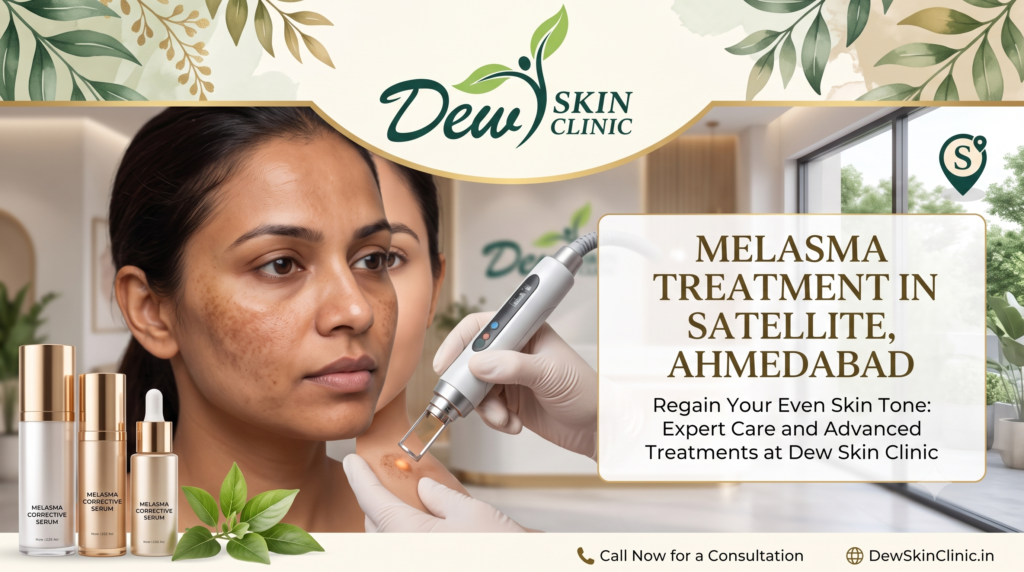
Melasma Treatment in Satellite, Ahmedabad: Causes, Options, Results & Expert Care
If you have brown or grey-brown patches on your cheeks, forehead or upper lip that return no matter which cream you try, you may be dealing with melasma. It is one of the most common pigmentation problems among Indian women, and it is especially stubborn in Gujarat’s hot, bright climate. The encouraging part is that melasma is manageable. With an accurate diagnosis, a doctor-designed plan and strict sun protection, most people see their patches lighten clearly and stay under control.
This guide covers what people searching for melasma treatment in Satellite, Ahmedabad usually want to know: what melasma is, why it appears, which treatments genuinely work on Indian skin, how long results take and how to choose the right specialist. Whether you live in Satellite or travel from Jodhpur, Prahlad Nagar, Vastrapur, Bodakdev or Ambawadi, it is written to help you decide with confidence. It comes from the dermatology team at Dew Skin Clinic, a trusted dermatology clinic in Satellite, Ahmedabad.
Quick Answer: Can Melasma Be Treated in Satellite, Ahmedabad?
Melasma is a harmless but persistent pigmentation disorder triggered by sun, hormones and heat. No single procedure cures it, but a dermatologist-guided plan combining prescription creams, gentle peels, laser toning and daily sunscreen can lighten patches and keep them controlled. Most people notice early change within four to eight weeks.
What Is Melasma? Understanding Dark Patches on the Face
Melasma is an acquired skin condition in which pigment-producing cells called melanocytes become overactive and deposit excess melanin in the skin. The result is symmetrical, flat patches ranging from light tan to deep brown or bluish-grey. The usual sites are the cheeks, forehead, nose bridge, upper lip and jawline. Less often it appears on the forearms and neck.
It is far more common in women, particularly between 20 and 50 years of age, but men can develop it too. People with medium to brown skin tones, which includes most of the Indian population, are at higher risk because their melanocytes react strongly to triggers. Melasma is not contagious, not cancerous and not painful, yet the emotional impact is real. Many patients avoid photographs, skip social events or rely on heavy makeup every day.
It is also important to separate melasma from other dark spots. Post-acne marks, sun spots and freckles can look similar but need different handling. If you also struggle with dull, uneven skin tone or dark circles, a dermatologist can tell you which concerns are melasma and which are not.
Causes and Triggers of Melasma in Ahmedabad’s Climate
Melasma rarely has a single cause. It is usually a mix of internal and external factors, and knowing your personal triggers is half the battle.
Sun Exposure and Heat
Ultraviolet and visible light stimulate melanocytes directly. Ahmedabad has intense sunshine for most of the year, and commuting along Satellite Road, S.G. Highway or the BRTS corridor on a two-wheeler exposes your face for long periods. Heat from kitchens, hot cars and crowded traffic can also worsen patches, which is why melasma often flares in summer.
Hormonal Changes
Pregnancy, birth control pills, hormone therapy, thyroid disorders and conditions such as PCOS are strongly linked to melasma. Some women first notice it during pregnancy, and it may fade or persist afterwards.
Genetics and Skin Type
A family history raises your risk substantially. If your mother or sister has melasma, mention it to your dermatologist.
Skincare and Lifestyle Triggers
Harsh scrubs, unsupervised lightening creams containing steroids, facial waxing, home remedies such as lemon or baking soda, and certain fragrances or medicines can inflame skin and worsen pigment. Stress and poor sleep may contribute too, although the evidence is less certain.
Types of Melasma and How a Dermatologist Diagnoses It
Treatment success depends heavily on the depth of pigment. Dermatologists usually classify melasma into three types:
- Epidermal melasma: pigment sits in the upper layer, patches look brown with sharp borders, and response is usually best.
- Dermal melasma: pigment lies deeper, patches look bluish-grey with blurred edges, and improvement is slower.
- Mixed melasma: the most common form in Indian patients, combining both depths.
Diagnosis begins with a detailed history: when the patches appeared, pregnancy or hormone use, medicines, sun habits, skincare products and family history. The doctor examines your skin in good light and may use dermoscopy, a magnified, non-invasive view that helps distinguish melasma from other pigment disorders. In selected cases, blood tests for thyroid or hormones may be advised. Bring a list of every cream, tablet and supplement you use, because some can make skin more sun-sensitive and influence the plan. You can read more on our pigmentation and melasma treatment page.
Melasma vs Other Pigmentation: How to Tell the Difference
Not every dark patch is melasma, and treating the wrong condition wastes time and money. As a general guide:
- Melasma: symmetrical, blotchy patches on the cheeks, forehead and upper lip, worsened by sun and hormones.
- Post-acne marks: flat brown or red spots where pimples healed, often scattered rather than symmetrical. Our guide to acne pimple treatment in Satellite, Ahmedabad explains how to control breakouts before pigment sets in.
- Sun spots and freckles: small, well-defined spots on sun-exposed areas rather than broad patches.
- Post-inflammatory hyperpigmentation: darkening after irritation, burns, rashes or aggressive treatments.
Because these conditions often overlap, an in-person examination is the only reliable way to know what you have. Wider options are also outlined on our pigmentation treatment service page.
Melasma Treatment Options Available in Satellite, Ahmedabad
There is no one-size-fits-all melasma treatment. At Dew Skin Clinic, plans are built around your melasma type, skin sensitivity, lifestyle and timeline. Most patients receive a combination approach, because targeting pigment through several pathways works better than relying on one.
Prescription Creams and Oral Support
Topical therapy is the foundation. Dermatologists commonly prescribe combinations of depigmenting and pigment-regulating ingredients such as hydroquinone, tranexamic acid, azelaic acid, kojic acid, niacinamide, vitamin C and retinoids, chosen and cycled carefully to avoid irritation or rebound darkening. In some patients, doctors may add oral tranexamic acid after safety screening. These are prescription decisions and should never be self-started from internet advice.
Chemical Peels for Melasma
Superficial peels using glycolic, lactic, mandelic, salicylic or azelaic acid help exfoliate pigmented cells and even out tone. Peels chosen for melasma are gentle and low in strength, because aggressive peeling can inflame Indian skin and worsen patches. Our chemical peels treatment is performed as a series, typically every two to four weeks.
Laser Toning and Q-Switched Nd:YAG Laser
Low-fluence laser toning is a popular melasma laser treatment because it breaks pigment into tiny particles gradually, with minimal downtime. It is delivered across multiple sessions at conservative settings. Learn more about laser toning and carbon laser facial or our Q-switched Nd:YAG laser service. Settings must stay gentle, since overheating pigmented skin is a classic reason melasma gets worse.
Microneedling and Mesotherapy
Microneedling creates controlled micro-channels that stimulate renewal and help brightening actives penetrate. Mesotherapy places small amounts of vitamins, amino acids and brightening agents into the superficial skin. Both suit patients who want better texture and radiance alongside pigment control.
Glutathione and Skin-Brightening Support
Some patients choose antioxidant support such as glutathione as an add-on for overall brightness. It is not a stand-alone melasma cure and results vary, but it may complement clinic care under medical supervision. See our guide to IV glutathione in Satellite, Ahmedabad or the overview of glutathione IV treatment.
Exosome Therapy for Stubborn Pigmentation
For resistant or recurrent cases, some clinics use regenerative options such as exosome therapy to calm inflammation and support repair. Evidence is still developing, so your doctor should explain honestly what to expect.
Melasma Treatments at a Glance
| Treatment | Best for | Downtime | Typical sessions |
|---|---|---|---|
| Prescription creams | All types, first step | None | Ongoing |
| Superficial peels | Epidermal, mixed | Mild flaking | 4 to 6 |
| Laser toning | Mixed, stubborn patches | Minimal | 6 to 10 |
| Microneedling | Texture plus pigment | 1 to 2 days redness | 3 to 5 |
| Mesotherapy | Dullness, tone | Minimal | 4 to 6 |
Session numbers are general guides only. Your dermatologist will confirm what suits your skin.
Melasma During Pregnancy and Breastfeeding: What Is Safe?
Often called the mask of pregnancy, melasma is common when hormones surge. Many popular ingredients, including hydroquinone, retinoids and oral tranexamic acid, are usually avoided during pregnancy and breastfeeding. Instead, doctors focus on strict sun protection, mineral-based sunscreen, gentle moisturisation and, where suitable, safer topical options. Stronger procedures are typically postponed until after delivery and weaning. If you are pregnant or planning pregnancy, tell your dermatologist first so your plan stays safe for you and your baby.
Your Melasma Treatment Journey Step by Step
- Consultation and skin analysis: history, examination, dermoscopy and baseline photographs.
- Personalised plan: the doctor explains your type, options, expected sessions, home routine and realistic outcomes.
- Skin preparation: if your skin is irritated, one to two weeks of barrier repair and sunscreen comes first.
- In-clinic sessions: peels, laser toning or microneedling, spaced two to four weeks apart.
- Review and adjustment: progress photos guide changes to actives and procedures.
- Maintenance: long-term sun protection and occasional touch-ups keep results stable.
Daily Skin Care Routine to Control Melasma
Clinic procedures only work when daily habits support them. Patients who follow a simple routine consistently tend to see faster results and fewer relapses.
Sunscreen Is Non-Negotiable
Use a broad-spectrum sunscreen of SPF 30 to 50 every morning, ideally a tinted or iron-oxide formula, because visible light also darkens melasma. Apply about two finger-lengths for the face, reapply every two to three hours outdoors, and wear it even on cloudy days. Add a hat, sunglasses and a scarf when riding.
Gentle Cleansing and Moisturising
Use a mild cleanser and a barrier-repairing moisturiser. Dry, irritated skin makes pigment worse. Medical facials such as HydraFacial can be added only if your doctor approves.
Do’s and Don’ts
- Do: follow the prescribed routine, take progress photos monthly and attend follow-ups.
- Do: avoid peak sun between late morning and mid-afternoon when possible.
- Don’t: use scrubs, waxing, bleach or unsupervised steroid creams.
- Don’t: stop treatment the moment patches lighten.
How Long Does Melasma Treatment Take? Results and Cost Factors
Most patients notice early lightening in four to eight weeks. Significant improvement often takes three to six months, and dermal melasma may take longer. Because melasma is chronic, it can return with sun, pregnancy or hormonal change, so maintenance is part of the plan.
The cost of melasma treatment in Satellite, Ahmedabad depends on:
- Type and severity of melasma
- Number and type of sessions
- Technology and products used
- Home-care medicines and follow-ups
We do not quote fixed prices online because plans differ widely. You receive a clear estimate after consultation.
Common mistakes that delay results include stopping early, using steroid creams, skipping sunscreen and expecting overnight change.
When Should You See a Dermatologist for Melasma?
Book a consultation if patches are spreading, darkening despite sunscreen, appeared after starting a new medicine or contraceptive, or have not improved after weeks of over-the-counter lightening creams. See a doctor promptly if a dark spot is asymmetrical, has irregular edges, changes quickly, bleeds or itches, because these signs can point to something other than melasma and need proper evaluation.
Why Choose Dew Skin Clinic for Melasma Treatment Near Satellite, Ahmedabad?
Melasma needs patience and precision, and that is where a doctor-led approach matters. Under the guidance of Dr. Vishal H. Shroff, our care rests on a few principles:
- Diagnosis first: we identify your type and triggers before choosing procedures.
- Skin-of-colour awareness: conservative settings protect Indian skin from rebound pigmentation.
- Transparent plans: you know the steps, timeline and likely outcomes.
- Complete care: if you also need acne scar treatment in Satellite or anti-aging skin treatment near Satellite, it can be planned together.
You can also read real patient testimonials before booking.
Living elsewhere in the city? See our pages for melasma treatment near Vaishno Devi Circle, in Motera, in Chandkheda and in Adalaj.
Frequently Asked Questions About Melasma Treatment in Satellite, Ahmedabad
Can melasma be cured permanently?
Melasma can be controlled and significantly improved, but it tends to relapse when triggers return. Consistent sunscreen and maintenance care are what keep results lasting.
Is laser toning safe for Indian skin?
When performed at low, conservative settings by an experienced doctor, laser toning is widely used for Indian skin. Incorrect settings can worsen pigment, so choose a dermatologist-led clinic.
How much does melasma treatment cost in Satellite, Ahmedabad?
Cost depends on severity, the procedures selected and the number of sessions. A consultation allows the doctor to give an accurate estimate for your plan.
Can melasma go away on its own?
Pregnancy-related melasma sometimes fades after delivery, but many cases persist without treatment. A dermatologist can advise the safest approach, especially if you are breastfeeding.
Can men get melasma?
Yes. It is less common than in women but affects men too, and treatment principles are similar.
How often should I visit the clinic during treatment?
Most procedures are spaced two to four weeks apart, with a review at every visit. Your doctor adjusts the interval based on how your skin responds. Patients from Satellite often find it convenient to schedule visits around office hours or school runs, and spaced-out sessions make that easy to plan.
Which is better for melasma: chemical peels or laser toning?
Neither is universally better. Peels often suit epidermal melasma, while laser toning is commonly added for mixed or stubborn patches. Many people benefit from a carefully sequenced combination.
Book Your Melasma Consultation in Satellite, Ahmedabad
Stubborn patches do not have to define your skin. A proper diagnosis, a gentle combination plan and daily sun care can restore even tone and confidence. To begin, book an appointment with our dermatology team, or contact us with any questions. You can also browse more skin guidance on our blog.
This article is for education only and does not replace medical advice. Treatment results vary by individual.