Mole Removal Treatment in Science City Road Ognaj, Ahmedabad: Safe, Doctor-Led Care at Dew Skin Clinic
A mole that bothers you every time you look in the mirror, catches on clothing, or has started to look different deserves a proper medical opinion. If you live or work near Science City Road in Ognaj, Ahmedabad, safe mole removal treatment is available close to home at Dew Skin Clinic. Our dermatologist-led team examines every mole before treating it, chooses the right method for its depth and location, and focuses on clean results with minimal scarring.
This detailed guide explains what mole removal treatment involves, which moles can be removed for cosmetic reasons, which ones need testing first, how CO2 laser, radiofrequency and electrocautery compare, what recovery looks like, and how to choose the right mole removal clinic near Science City Road, Ognaj. Whether the mole sits on your face, neck, back or hands, this page covers what to expect from the first consultation to full healing.
What Is Mole Removal Treatment and Who Needs It?
A mole, medically called a nevus, is a cluster of pigment-producing cells that forms a small brown, black, pink or skin-coloured spot. Most adults have between ten and forty moles, and the vast majority are harmless. Mole removal treatment is a dermatology procedure that takes out a mole completely or reduces it so that it no longer affects your appearance or comfort.
People usually seek mole removal in Ahmedabad for four reasons:
- Cosmetic concern, especially when a raised mole sits on the cheek, nose, lip line or forehead.
- Irritation, when a mole is rubbed by a collar, bra strap, belt, razor or jewellery.
- Change in appearance, such as new colour, size, border or bleeding.
- Medical advice, when a doctor wants a mole examined or tested.
At Dew Skin Clinic, the first step is never the removal itself. It is a skin check by a qualified dermatologist, because the right answer for one mole may be removal, while for another it may be testing or simple monitoring. You can learn more about our complete mole removal treatment service on the main service page.
Types of Moles We Treat for Patients Near Science City Road, Ognaj
Not every mole looks the same, and the type often decides the removal technique.
Flat Moles (Junctional and Compound Nevi)
These sit level with the skin or are slightly raised. They are usually brown and uniform in colour. Flat moles on visible areas are common candidates for cosmetic mole removal using laser or radiofrequency.
Raised and Dome-Shaped Moles (Intradermal Nevi)
These are lifted above the skin, often skin-coloured or light brown, and sometimes carry a hair. Because pigment cells sit deeper, they may need shaving, radiofrequency or excision for a smooth result.
Congenital Moles and Birthmarks
Moles present from birth vary widely in size. Larger ones need careful assessment before any procedure. If your concern is a larger pigmented patch, our page on birthmark removal treatment explains the options in detail.
Skin Tags and Warts Mistaken for Moles
Many patients arrive asking about mole removal when the growth is actually a soft skin tag or a viral wart. These need different treatment, and you can read about skin tag removal and verruca and warts treatment separately.
When to Get a Mole Checked Before Mole Removal
Most moles are harmless, but certain changes should be examined by a dermatologist before any removal. Doctors commonly use the ABCDE guide:
- Asymmetry: one half of the mole does not match the other half.
- Border: edges are irregular, notched or blurred.
- Colour: more than one shade, such as brown, black, red or blue within the same mole.
- Diameter: larger than about 6 millimetres, roughly the size of a pencil eraser.
- Evolving: any change in size, shape, colour, height, itching or bleeding.
A new mole that appears after adulthood, a mole that looks very different from your other moles, or one that bleeds or crusts without injury should be seen promptly. Do not try to cut, burn or scrape a mole at home, and avoid unverified home remedies sold online. Self-removal can cause infection, deep scarring and delay in identifying a problem. For general awareness, our article on why regular skin cancer screenings are important explains why periodic skin checks matter for everyone.
Dermoscopy and Skin Biopsy Before Mole Removal in Ognaj, Ahmedabad
Responsible mole removal treatment starts with evaluation, not equipment.
Dermoscopy Mole Mapping
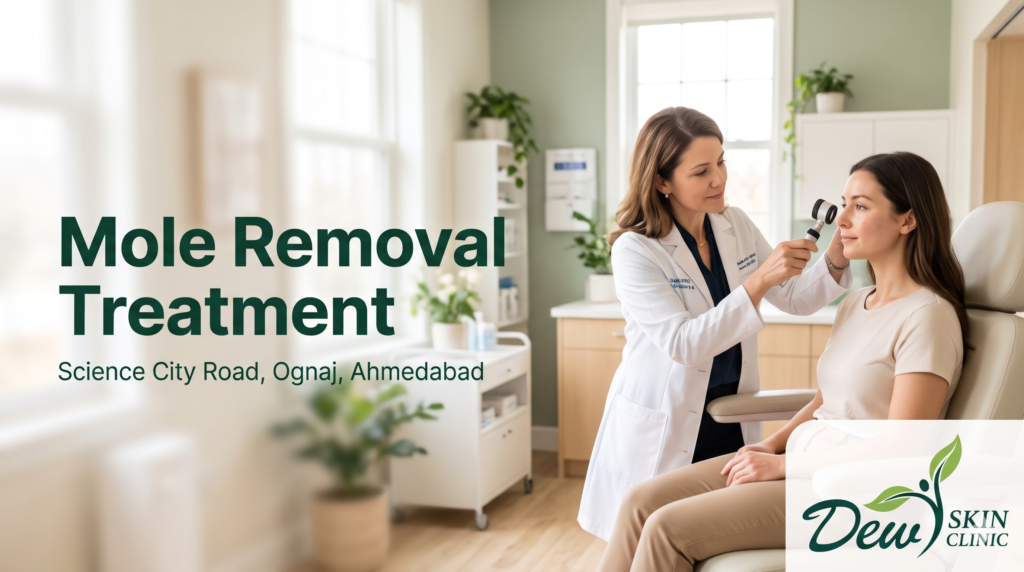
Dermoscopy uses a magnifying instrument with special lighting to look at pigment patterns beneath the skin surface. It lets the dermatologist see structures that are invisible to the naked eye and decide whether a mole looks routine or needs further attention. Learn how this works on our dermoscopy examination page.
Skin Biopsy and Histopathology
If a mole looks unusual, the dermatologist may recommend a small sample or complete excision that is sent to a laboratory for histopathology. This is the only way to confirm what a mole truly is. Our skin biopsy service is designed for exactly this situation.
This is also why a clinic setting matters. Removing a mole without any examination can leave a questionable lesion untested. When a clinician confirms a mole is benign, cosmetic removal can proceed with confidence.
Mole Removal Methods Used at Dew Skin Clinic
There is no single technique that suits every mole. The dermatologist selects a method based on the mole’s size, depth, colour, location and your skin type.
CO2 Laser Mole Removal
A fractional or ablative CO2 laser vaporises the mole tissue layer by layer with very high precision. It is popular for facial moles because the surrounding skin is affected minimally and the depth can be controlled carefully. You can read more about this technology on our CO2 laser and electrocautery treatment page and the dedicated CO2 laser service page.
Radiofrequency Mole Removal
Radiofrequency uses controlled high-frequency energy to remove raised moles with less bleeding. It works well for dome-shaped moles on the face and neck, and it allows the doctor to shape the area smoothly. See how this works on our radiofrequency and electrocautery page.
Electrocautery Mole Removal
Electrocautery uses a fine heated tip to remove small, superficial moles and seal tiny blood vessels at the same time. It is quick, effective for suitable lesions and commonly used for multiple small moles during one visit.
Surgical Excision
When a mole is deep, large or needs laboratory testing, the doctor removes it with a scalpel and may place fine stitches. This method is the preferred choice when histopathology is required because the entire lesion can be examined.
Cryotherapy for Selected Growths
Freezing therapy suits certain warts and superficial growths but is generally not the first choice for true pigmented moles. If the doctor finds that your growth is better treated with freezing, you can read about cryotherapy treatment at our clinic, and about cryotherapy near Science City Road in Ognaj.
Step-by-Step Mole Removal Procedure at Our Ognaj-Area Skin Clinic
Knowing the process makes the experience far less stressful. A typical visit looks like this:
- Consultation and skin examination. The dermatologist reviews your medical history, allergies, medicines, healing tendencies and any history of keloid scarring.
- Dermoscopy and decision. Your mole is examined closely, and the safest removal method is recommended. If testing is advised, a biopsy or excision is planned.
- Cleansing and marking. The area is cleaned, and the mole boundary is identified.
- Local anaesthesia. A numbing cream or a small local injection is used so the procedure is comfortable.
- Removal. Laser, radiofrequency, electrocautery or excision is performed. A single small mole usually takes only a few minutes.
- Dressing and instructions. A protective dressing or ointment is applied, and you receive clear aftercare steps.
- Follow-up. A review visit lets the doctor check healing and decide whether any touch-up is needed.
Most patients walk out of the clinic the same day and return to routine activities quickly, although the treated area needs gentle care.
Mole Removal Aftercare: Healing, Scabs and Sun Protection
Good aftercare has a major effect on how the final mark looks.
- Keep the area clean and dry for the first day, or as advised by your dermatologist.
- Apply only the ointment or cream prescribed to you.
- Do not pick, scratch or peel the scab. It falls off naturally, usually within one to two weeks depending on the area.
- Avoid hot saunas, steam, swimming pools and heavy sweating until the skin has closed.
- Protect the area from sunlight with a broad-spectrum sunscreen once the doctor allows it, because new skin darkens easily.
- Avoid makeup directly on the wound until it has healed.
- Attend your follow-up visit so any redness or pigment change is addressed early.
Mild redness, slight swelling or a pink patch for a few weeks is common. Contact the clinic if you notice increasing pain, pus, spreading redness or fever, as these can indicate infection.
Mole Removal Scars, Pain and Results: What Is Realistic?
Patients often ask whether mole removal leaves a mark. The honest answer is that every method that removes tissue creates a healing wound, so some change in the skin is possible. The goal of a skilled dermatologist is to keep that change as small and as flat as possible.
Factors that influence the final look include mole depth, body area, your skin tone and your natural healing tendency. Moles on the chest, shoulders and upper back are more prone to marks than moles on the face. If a faint pink or lighter patch remains, it commonly fades gradually over several months. In some cases, scar-improvement options such as microneedling can be discussed to refine skin texture.
Pain is usually minimal because the skin is numbed beforehand. You may feel pressure or a brief warm sensation, but not sharp pain. Results vary from person to person, and your doctor will set realistic expectations during consultation.
Mole Removal vs Skin Tag, Wart and Birthmark Treatment
Because several skin growths look alike, a proper diagnosis prevents wasted effort.
- Mole: pigmented cells, usually brown or black, can be flat or raised and present for years.
- Skin tag: soft, flesh-coloured, hangs from a small stalk, common on the neck and underarms.
- Wart: rough surface, caused by a virus, may spread to nearby skin.
- Birthmark: present from birth or early childhood, ranging from pigmented to vascular patches.
Your dermatologist will confirm the diagnosis, and if the growth turns out to be something else, the correct treatment will be offered instead. This is a good reason to visit a clinic rather than guess based on photographs.
Why Choose Dew Skin Clinic for Mole Removal Near Science City Road, Ognaj
Choosing where to remove a mole is a medical decision, not just a cosmetic one. Patients from Ognaj, Science City Road, Sola, Gota, Thaltej and nearby areas choose Dew Skin Clinic for these reasons:
- Dermatologist-led care. Every mole is assessed by a qualified skin specialist before treatment. Meet the doctor on the page of Dr. Vishal H. Shroff.
- Advanced technology. CO2 laser, radiofrequency and electrocautery allow the technique to be matched to each mole.
- Diagnosis first. Dermoscopy and biopsy options help ensure suspicious moles are not treated casually.
- Clean, hygienic clinic protocols. Sterile instruments and a controlled procedure environment support safe treatment.
- Personalised plans. Your skin type, lifestyle and expectations shape the treatment recommendation.
- Complete skin solutions. If you also want help with pigmentation, acne marks or hair concerns, our wider range of dermatology services in Ahmedabad is available under one roof.
You can also read what patients say on our testimonials page and explore the clinic’s broader approach on the Dew Skin Clinic home page.
Mole Removal Cost in Ahmedabad: What Affects the Price?
The cost of mole removal treatment is not fixed because every mole is different. The final fee depends on:
- The number of moles being treated.
- The size, depth and location of each mole.
- The technique selected, such as laser, radiofrequency or surgical excision.
- Whether laboratory testing is needed.
- Follow-up visits and aftercare products.
The most reliable way to get an accurate quote is a consultation, where the doctor can see the mole in person. Avoid choosing a provider only because the price is the lowest, since safety and diagnosis matter far more with moles than with many other cosmetic procedures.
Mole Removal Treatment Across Ahmedabad Localities
If Science City Road, Ognaj is not the most convenient location for you, Dew Skin Clinic also serves patients from other parts of Ahmedabad. Our local guides cover mole removal in Chandkheda, mole removal in Motera, mole removal in Adalaj, mole removal near Vaishno Devi Circle, mole removal near Jagatpur, mole removal in Prahlad Nagar and mole removal near Satellite.
If you are visiting for other skin concerns in the same area, you may also find these local pages useful: melasma treatment in Science City Road, acne and pimple treatment in Science City Road and trusted dermatology clinic in Science City Road.
Mole Removal Treatment FAQs for Science City Road, Ognaj, Ahmedabad
Is mole removal treatment safe?
Yes, when performed by a qualified dermatologist after proper examination, mole removal is a well-established and safe procedure. Safety depends on correct diagnosis, sterile technique and appropriate aftercare.
Will the mole grow back after removal?
Some moles can return if a few pigment cells remain beneath the skin, particularly with superficial removal of deeper moles. If a mole reappears, especially with irregular colour, have it examined promptly.
How long does mole removal take?
A single small mole often takes only a few minutes, plus preparation time for numbing. Multiple or deeper moles take longer.
Does mole removal hurt?
Numbing cream or local anaesthesia keeps the procedure comfortable. Mild tenderness for a day or two afterward is normal.
How long does it take for the area to heal?
Superficial treatments commonly heal within one to two weeks, while excisions with stitches need longer. Redness can fade over several weeks to months.
Can I remove multiple moles in one session?
In many cases, yes, particularly small benign moles treated with laser, radiofrequency or electrocautery. Your dermatologist will decide after examining them.
Should I get a mole tested after removal?
If the doctor has any concern, the removed tissue is sent for histopathology. Ask during consultation whether testing is advisable for your mole.
Book Your Mole Removal Consultation in Science City Road, Ognaj, Ahmedabad
If a mole is affecting your confidence, causing irritation or looking different from before, do not wait or experiment at home. A short examination can give you clarity and a safe treatment plan. Reach out through our contact page or book an appointment online with Dew Skin Clinic today, and take the first step toward clearer, healthier-looking skin. For quick answers about visits and procedures, you can also check our frequently asked questions.
Disclaimer: This article is for general information and does not replace a medical consultation. Results vary between individuals. Any mole that changes in size, colour or shape should be examined by a qualified dermatologist.