
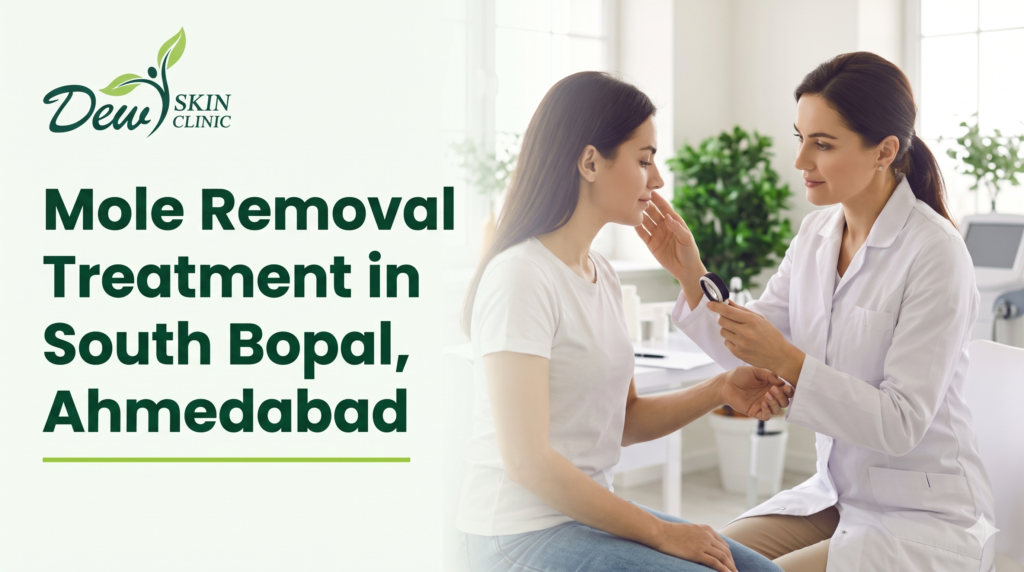
If you have been searching for mole removal treatment in South Bopal, Ahmedabad, you are probably dealing with a spot that bothers you every time you look in the mirror, catches on your clothing, or has started to look different from before. Moles are extremely common, and most of them are harmless. But the decision to remove one should never be casual. A mole on your face, neck, back or scalp deserves a proper skin examination first, followed by a removal method that suits its depth, size and location.
At Dew Skin Clinic, mole removal is handled as a medical procedure, not a quick beauty shortcut. Every case starts with a dermatologist’s assessment, and only then do we decide whether the mole should be removed, how it should be removed, and whether the tissue needs to be tested. This guide explains everything a resident of South Bopal should know before booking: what moles are, which methods work, what the procedure feels like, how healing goes, what affects the cost, and how to choose a safe clinic.
If you want a quick overview of the service before reading further, you can visit our main mole removal treatment page.
What Are Moles and Why Do People Remove Them?
A mole, medically called a melanocytic nevus, is a cluster of pigment-producing cells in the skin. Moles can be flat or raised, light brown or very dark, smooth or slightly hairy. Most people have between ten and forty of them, and many appear during childhood and the teenage years. Hormonal changes, pregnancy and sun exposure can make new ones appear or change existing ones.
People choose mole removal in South Bopal for several reasons:
- Cosmetic concern: A prominent mole on the cheek, nose, lip or forehead can affect confidence.
- Daily irritation: Moles on the neck, bra line, waistband, armpit or beard area can get rubbed, scratched or nicked while shaving.
- Medical suspicion: A mole that changes shape, colour or size needs to be examined and, if advised, removed and tested.
- Raised or hairy moles: Some people simply want a smoother skin surface.
- Bleeding or itching: A mole that bleeds without injury or keeps itching should be checked promptly.
It is important to understand that not every mole needs removal. Many are completely harmless and can be left alone. A dermatologist will tell you honestly whether treatment is necessary or only a matter of preference.
When Should You Get a Mole Examined Before Removal?
Safe mole removal always begins with an examination. Dermatologists use the ABCDE guide to spot warning signs:
- Asymmetry: One half of the mole does not match the other half.
- Border: The edges are blurred, notched or irregular.
- Colour: The mole has several shades, such as brown, black, red or blue-grey.
- Diameter: It is larger than about 6 mm, roughly the width of a pencil eraser.
- Evolution: It is growing, changing, crusting, itching or bleeding.
If any of these signs apply to you, please do not try home remedies or visit an unqualified beauty parlour. The right first step is a clinical check. At Dew Skin Clinic, we use dermoscopy, a painless magnified examination of the skin, to study the mole’s pattern and pigment network before any decision is made. Where a mole looks unusual, the tissue can be sent for a skin biopsy so that a pathologist can confirm what it is.
Regular checks matter even if nothing looks wrong. Our article on why regular skin cancer screenings are important explains how early detection protects your health and gives you peace of mind.
Mole Removal Methods Available at Dew Skin Clinic
There is no single best technique for every mole. The right method depends on how deep the mole sits, how large it is, where it is located and whether the tissue should be tested afterwards. Here are the main approaches used in modern dermatology.
CO2 Laser Mole Removal
A carbon dioxide laser removes thin layers of tissue with great precision. It is popular for small, raised, non-suspicious moles, especially on the face, because the surrounding skin is barely affected and bleeding is minimal. Healing is usually clean, and the treated area gradually blends with the surrounding skin. You can read more about this technology on our CO2 laser and electrocautery treatment page.
Electrocautery and Radiofrequency Removal
In electrocautery or radiofrequency removal, a fine probe uses controlled heat energy to remove the mole and seal tiny blood vessels at the same time. This method is quick and works well for small, superficial, raised moles on the face, neck and body. Because it seals the area as it works, bleeding is very limited.
Cryotherapy for Superficial Growths
Cryotherapy uses extremely cold treatment to destroy small superficial skin growths. It is not suitable for every mole, but it is often chosen for warts and certain surface lesions that can look similar to moles. If you are unsure what your growth actually is, our dermatologist will examine it first. You can learn more about cryotherapy treatment and its uses, and local residents can also see our page on cryotherapy treatment in South Bopal, Ahmedabad.
Surgical Excision and Punch Removal
For deeper moles, larger moles, or any mole that needs to be tested, surgical excision is usually the safest option. The mole is removed completely under local anaesthesia, the area is closed with fine stitches where required, and the tissue is sent to the laboratory. This is the preferred approach when there is any doubt about the nature of the mole. Our dermato surgery service covers these minor surgical procedures in a sterile clinical setting.
How Your Dermatologist Chooses the Right Method
The decision is made after the examination, not before it. A small, flat, harmless-looking mole on the cheek may be ideal for laser. A suspicious pigmented lesion will need excision and testing. A hairy raised mole on the neck may respond well to radiofrequency. This is exactly why a doctor-led clinic is a safer choice than any place that promises the same quick fix for every mole.
Why Choose Dew Skin Clinic for Mole Removal in South Bopal?
Choosing where to get a mole removed is a health decision. Here is what residents of South Bopal, Ghuma, Shela and Bopal can expect from us:
- Dermatologist-led care: Your skin is examined and treated by a qualified dermatologist. You can learn more about Dr. Vishal H. Shroff and our approach on his profile page.
- Diagnosis before treatment: Dermoscopy and, when needed, biopsy come before removal, not after complications.
- Multiple techniques under one roof: Laser, radiofrequency, cryotherapy and minor surgery allow us to match the method to the mole.
- Hygiene and safety: Single-use consumables, sterile instruments and clean procedure rooms are non-negotiable.
- Clear communication: We explain the procedure, expected healing, possible marks and aftercare in plain language before you decide.
- Convenient location for South Bopal residents: Patients from South Bopal and nearby areas of western Ahmedabad can reach us without crossing the whole city. Our dedicated page for a trusted dermatology clinic in South Bopal, Ahmedabad gives more details about care for the area.
To get a sense of what other people say about their experience, you can browse our patient testimonials and learn more about Dew Skin Clinic.
Step-by-Step: What Happens During Mole Removal?
Knowing what to expect removes most of the anxiety. A typical visit follows these steps.
1. Consultation and skin examination. The dermatologist asks how long you have had the mole, whether it has changed, and whether there is a family history of skin problems. The mole is examined closely, usually with dermoscopy.
2. Treatment plan. You are told whether removal is necessary, which method is recommended, whether testing is advised, and what the likely result will be.
3. Cleaning and numbing. The skin is cleaned and a local anaesthetic is applied or injected. Most patients feel only a brief pinch or pressure.
4. Removal. Depending on the plan, the mole is removed with laser, radiofrequency, or surgical technique. Small moles take only a few minutes. Larger ones can take somewhat longer.
5. Dressing and instructions. A protective dressing is applied if needed, and you receive clear aftercare instructions.
6. Follow-up. If the tissue was sent for testing, we review the report with you. Follow-up visits are scheduled to check healing.
Most patients walk in and walk out on the same day and return to normal routines the same day or the next. Your doctor will advise you based on the location of the mole.
Aftercare and Healing Timeline
Good aftercare has a large effect on how the skin looks once healing is complete. In general:
- Days 1 to 3: The area may be slightly red, tender or covered with a small dressing. Keep it clean and dry as advised.
- Days 4 to 10: A thin crust or scab forms in many cases. Do not pick or scratch it. Let it fall off naturally.
- Weeks 2 to 4: The new skin is often pink. It gradually matches your natural tone.
- Months 2 to 3: Pinkness continues to fade, and the final texture becomes clear.
Practical tips that help most patients:
- Apply only the ointment or cream your doctor prescribes.
- Protect the area from sunlight with a broad-spectrum sunscreen once the wound has closed, because fresh skin is prone to dark marks.
- Avoid swimming, heavy sweating, steam or harsh scrubs until you are advised it is safe.
- Do not use homemade pastes, acids or herbal mixtures on the area.
- Contact the clinic if you notice increasing pain, pus, swelling or spreading redness.
Will Mole Removal Leave a Scar?
This is the most common worry we hear. Any method that removes skin tissue can leave some mark, but a skilled dermatologist keeps this minimal. Superficial laser or radiofrequency removal on small moles often leaves only a faint, flat, slightly pink or pale area that fades over time. Surgical excision leaves a fine line scar, which is placed along natural skin creases wherever possible. People with darker skin tones, which are common in India, can develop temporary dark marks after healing, and this is why sun protection and following instructions are so important.
If you already have marks from earlier treatment, spots or acne, our skin texture and scars treatment options can help improve the overall look of the skin after the mole has healed.
Mole Removal Cost in South Bopal, Ahmedabad
Patients often ask for one fixed figure, but a responsible clinic cannot quote a price without seeing the mole. The cost of mole removal depends on several factors:
- Number of moles: Treating several moles in one session is usually planned differently from removing a single one.
- Size and depth: Larger or deeper moles need more time and sometimes stitches.
- Technique used: Laser, radiofrequency, cryotherapy and surgical excision differ in equipment and time.
- Location: Moles near the eyes, lips or nose require extra care and precision.
- Laboratory testing: If a biopsy is advised, pathology charges apply.
- Follow-up care: Medication, dressings and review visits form part of the plan.
The best approach is to book a consultation. You will receive a clear explanation of the recommended plan and the cost before any procedure begins.
Mole, Skin Tag, Wart or Birthmark: Why the Difference Matters
Many growths look alike to the untrained eye, and treating them wrongly can cause problems. A soft, hanging piece of skin is more likely a skin tag, which has its own approach. You can read about skin tag removal treatment here. A rough, bumpy growth could be a wart caused by a virus, and our verruca and warts treatment page explains how these are managed. Patches present from birth are usually birthmarks, which are covered in birthmark removal treatment. A proper diagnosis ensures you receive the right treatment the first time.
Mole Removal for Residents Near South Bopal
Dew Skin Clinic serves patients from across Ahmedabad. If you live or work in other parts of the city, you may also find our local guides useful, including mole removal treatment near Satellite, Ahmedabad, mole removal treatment in Prahlad Nagar, Ahmedabad and mole removal near Jagatpur, Ahmedabad.
If you are also bothered by other concerns on the face, our South Bopal pages on acne and pimple treatment and melasma treatment can help you plan complete skin care in a single visit.
Frequently Asked Questions About Mole Removal in South Bopal
Is mole removal painful?
Local anaesthesia is used, so most people feel only slight pressure or a brief pinch. Mild tenderness for a day or two afterwards is normal and manageable.
Can a removed mole grow back?
Superficial removal can occasionally leave a few pigment cells behind, which may cause the mole to reappear partially. Complete excision lowers this chance. If a mole returns, have it examined rather than treating it again at home.
How long does mole removal take?
The procedure for a single small mole often takes only a few minutes, though the consultation, numbing and dressing make the full visit longer. Several moles or deeper removal take more time.
Is laser mole removal safe?
When performed by a qualified dermatologist with the right settings and after a proper examination, laser mole removal is considered safe for suitable moles. It is not meant for suspicious lesions that need testing.
Can I remove a mole at home?
We strongly advise against it. Home products, blades and acids can cause infection, deep scars and pigmentation, and they can hide a dangerous mole from proper diagnosis.
Will I need to send the mole for testing?
Not always. If the mole looks harmless on examination, testing may not be needed. If anything looks unusual, your dermatologist will advise a biopsy, and we believe in following that advice.
Book Your Mole Removal Consultation in South Bopal, Ahmedabad
A mole does not have to be a daily source of worry. Whether you want a smoother look, relief from irritation, or reassurance about a spot that has changed, the first step is the same: a careful examination by a dermatologist. Dew Skin Clinic offers safe, doctor-led mole removal treatment for patients in South Bopal, Ahmedabad, with honest advice, clear explanations and attentive aftercare.
You can book an appointment online, get answers on our frequently asked questions page, or contact us directly to plan your visit.
Disclaimer: This article is for general education and does not replace medical advice. Results, healing and suitability vary from person to person, and the right treatment can only be decided after an in-person consultation with a dermatologist.