Mole Removal Treatment Near Vaishno Devi Circle, Ahmedabad: A Complete Doctor-Led Guide
A mole that has been on your face since childhood can feel like part of who you are. A new dark spot on your back that you noticed last month can feel like a worry. Both situations lead people to search for mole removal treatment near Vaishno Devi Circle, and both deserve the same starting point: an examination by a qualified dermatologist, not a quick cosmetic fix.
At Dew Skin Clinic, mole removal in Ahmedabad is built around that principle. Every mole is examined first, and then a method is chosen to suit its depth, colour, size and location. Some moles are removed for cosmetic reasons, some because they rub against clothing or jewellery, and some because a doctor wants a closer look under the microscope.
This guide is written for people living and working around Vaishno Devi Circle, SG Highway and the neighbouring parts of north-west Ahmedabad. It explains what moles are, which warning signs matter, how each removal method works, what recovery looks like and what influences the cost, so you can decide with clear information and without pressure.
What Is a Mole, and Why Do People Choose Removal?
A mole, medically called a melanocytic naevus, is a cluster of pigment-producing cells in the skin. Most adults have somewhere between ten and forty, and the majority are harmless. They can be flat or raised, light brown or almost black, smooth or slightly hairy.
People usually choose professional mole removal for one of four reasons:
- Appearance: a prominent mole on the cheek, nose, lip or neck can affect confidence.
- Irritation: moles on the waistline, collar area, bra line or beard region get caught, scratched or bleed.
- Change: a mole that grows, darkens or alters its shape needs medical review.
- Peace of mind: some people simply want a doctor to confirm that a long-standing mole is safe.
Mole removal is a minor procedure, but it is still a medical one. That is why the first step at our clinic is a consultation, not a laser session. If you want a wider overview of the service, read about our mole removal treatment at Dew Skin Clinic.
When Should a Mole Be Checked Before Removal?
Before any removal, a mole needs to be judged on its own behaviour. Dermatologists use the ABCDE checklist, and you can use it at home too:
- Asymmetry: one half does not match the other.
- Border: the edge is blurred, notched or irregular.
- Colour: several shades of brown, black, red or blue appear within one mole.
- Diameter: it is larger than about 6 mm, roughly the size of a pencil eraser.
- Evolving: it has changed in size, shape, colour or texture over weeks or months.
Other signs deserve attention as well: a mole that bleeds without injury, itches persistently, forms a crust, or looks very different from your other moles (the “ugly duckling” sign). A brand-new mole appearing after the age of thirty is also worth showing to a doctor.
None of these signs automatically means cancer, but they do mean the mole should be examined with dermoscopy before anyone treats it. Our article on why regular skin cancer screenings are important explains how often adults should have their skin checked. Please avoid home remedies such as garlic, apple cider vinegar, acids or burning. These can scar the skin and may destroy tissue a pathologist would have wanted to examine.
Mole Removal Methods Available Near Vaishno Devi Circle
There is no single best technique. The right option depends on whether the mole is flat or raised, how deep it goes and whether it needs to be sent for testing. At Dew Skin Clinic, the dermatologist chooses among these approaches after examination.
Dermoscopy-Guided Assessment
Dermoscopy uses a magnifying, polarised-light device to see pigment patterns beneath the skin surface. It takes a few minutes, causes no pain, and helps your doctor decide whether a mole is suitable for cosmetic removal or needs a sample sent to the laboratory.
Radiofrequency and Electrocautery Removal
For small, raised, clearly benign moles, controlled radiofrequency or electrocautery removes the growth layer by layer under local anaesthetic. Heat seals tiny blood vessels, so bleeding is minimal. This approach is popular for facial moles because it is quick and precise. You can read more about CO2 laser and electrocautery treatment on our site.
CO2 Laser Mole Removal
A CO2 laser vaporises mole tissue in thin, controlled passes. It works well for small, flat-to-slightly-raised moles in cosmetically sensitive areas, offers good control over depth, and usually heals with a fine mark that fades. Because the tissue is vaporised, it is generally not chosen when the doctor wants a specimen for testing.
Shave Excision
The raised portion of the mole is shaved level with the surrounding skin using a fine blade. It is quick, needs no stitches, and the removed tissue can be sent for histopathology if required.
Punch or Surgical Excision
Deeper, larger or suspicious moles are best removed completely with a small surgical cut, often closed with a few fine stitches. This gives the pathologist a full sample and lowers the chance of regrowth. Our dermato-surgery service covers these minor procedures, and a skin biopsy may be advised first when the diagnosis is uncertain.
Where Cryotherapy Fits
Cryotherapy is useful for superficial growths such as warts and some skin tags, but it is usually not the preferred choice for true pigmented moles. If your growth turns out not to be a mole, our guide to cryotherapy treatment near Vaishno Devi Circle explains that option.
What Happens During Your Visit: Step by Step
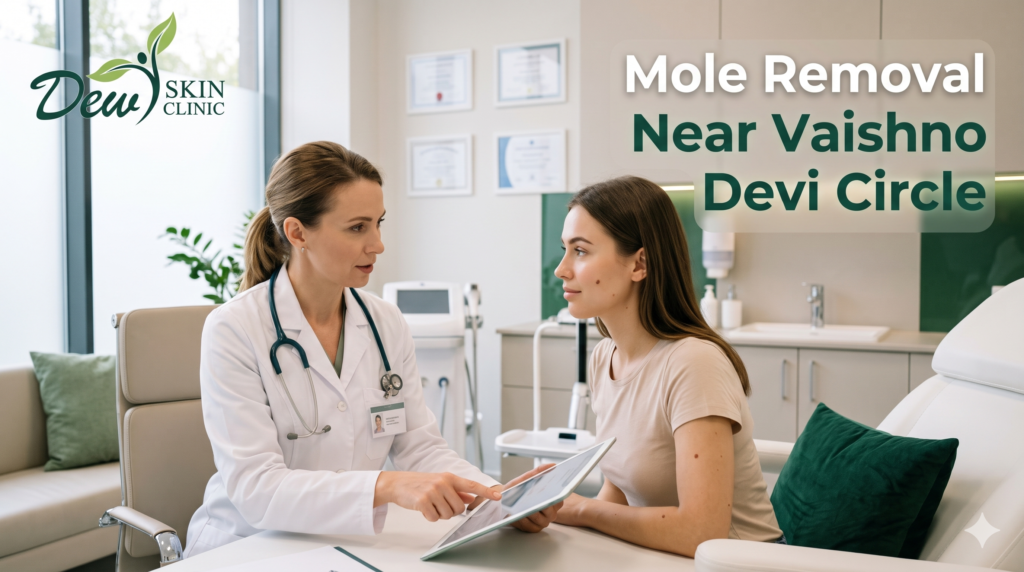
Knowing what to expect removes most of the nervousness. A typical visit follows this order:
- Consultation and history: the doctor asks how long the mole has been present, whether it has changed, and whether there is a family history of skin cancer.
- Dermoscopy: the mole is examined under magnification, and nearby moles are checked too.
- Method and consent: the doctor explains which technique suits your mole, what the likely result is, and whether lab testing is advised. You decide whether to proceed.
- Local anaesthetic and removal: the area is cleaned and numbed. The removal itself usually takes 10 to 30 minutes, depending on the number and size of moles.
- Dressing and instructions: a protective dressing is applied, and you receive clear written or verbal aftercare guidance.
- Report and review: if a sample was sent for histopathology, the report is reviewed with you at a follow-up visit.
Why Choose a Dermatologist Clinic Near Vaishno Devi Circle?
Vaishno Devi Circle sits on one of Ahmedabad’s busiest corridors, and many of our patients are professionals who cannot afford long travel or repeated visits. A clinic close to home or work makes follow-up reviews easier, and follow-up is part of safe mole care, not an optional extra.
Equally important is who treats you. You can meet Dr. Vishal H. Shroff and the clinical team before deciding on treatment. Our broader trusted dermatology clinic near Vaishno Devi Circle page explains how the clinic approaches skin, hair and cosmetic dermatology in general.
Look for these signs in any clinic you consider: the doctor examines the mole before quoting a price, instruments are sterile or single-use, the plan is explained in plain language, and a lab test is offered when the mole looks unusual. A clinic that promises “one-minute removal of any mole” without looking at it closely is not following good practice.
Mole Removal Cost Near Vaishno Devi Circle: What Affects the Price
Because every mole is different, a fixed price list can mislead. The main factors that shape the final cost are:
- The number of moles being treated in the same session.
- The size, depth and location of each mole, since a facial mole needs more care than a mole on the arm.
- The technique used, whether radiofrequency, laser, shave or surgical excision.
- Whether histopathology is required, which adds a laboratory fee.
- The number of follow-up visits needed for review or scar care.
The most reliable way to get an accurate figure is a short consultation, after which the doctor can explain the plan and the cost together. You can contact Dew Skin Clinic to ask about consultation timings.
Recovery and Aftercare: A Realistic Timeline
Healing differs from person to person, but this timeline is typical for minor removals:
- Day 0 to 2: mild redness, tenderness or a small scab. Keep the dressing clean and dry as advised.
- Day 3 to 7: a crust forms. Do not pick it. Picking raises the risk of infection and a deeper scar.
- Week 1 to 2: the crust falls off naturally, leaving pink or slightly darker skin underneath. Stitches, if used, are usually removed within this window.
- Week 2 to 6: the pink colour gradually settles. Sun protection matters most in this phase.
- Month 2 to 6: the mark continues to soften and blend in.
Throughout healing, apply only the ointment your doctor prescribes, use a broad-spectrum sunscreen once the skin has closed, avoid swimming pools and heavy sweating until the area is fully healed, and attend your review visit. If you notice increasing pain, pus, spreading redness or fever, contact the clinic promptly.
Scarring, Pigmentation and Regrowth: The Honest Picture
Every removal method leaves some mark, because the skin is healing a wound. With careful technique and good aftercare, most marks become flat, pale and barely noticeable. Deeper moles and moles on the chest, back or shoulders tend to scar more than facial ones.
Indian skin can also darken temporarily after any procedure, which is why sun protection is essential. If a lasting mark bothers you later, options for skin texture and scar treatment are available once the area has fully healed.
Regrowth is possible when a mole is removed only at the surface, since a few pigment cells can remain deeper. Show any regrown mole to your doctor instead of ignoring it.
Other Growths That Look Like Moles
Not every small bump is a mole. Soft, hanging growths on the neck and underarms are often skin tags. Rough, raised growths may be warts, and flat patches present from birth may be a birthmark. Each needs a different approach, which is another reason a proper examination comes first.
Frequently Asked Questions About Mole Removal Near Vaishno Devi Circle
Is mole removal safe near Vaishno Devi Circle?
Yes, when a qualified dermatologist examines the mole first, uses sterile instruments and chooses a method that suits it. At Dew Skin Clinic every mole is assessed with dermoscopy before treatment.
Is mole removal painful?
A local anaesthetic numbs the area, so you usually feel only light pressure or a brief pinch at the start. Mild tenderness for a day or two is common afterwards.
Will the mole come back?
Superficially treated moles can occasionally regrow because some pigment cells remain deeper. Complete surgical excision lowers this risk. Any regrowth should be shown to your doctor rather than ignored.
How long does the procedure take?
Most removals take 10 to 30 minutes, depending on the number, size and location of moles. Your consultation and dermoscopy check are usually done on the same visit.
Can I return to work the same day?
Usually yes, since the procedure is minor. Keep the dressing clean and dry, avoid heavy sweating and sun on the area, and follow the aftercare instructions you receive.
Book Your Mole Check Near Vaishno Devi Circle
Whether your mole bothers you for how it looks, how it feels or how it has changed, the safest first step is the same: let a dermatologist examine it. At Dew Skin Clinic, you get a clear diagnosis, an honest explanation of your options and careful aftercare, all within easy reach of Vaishno Devi Circle and SG Highway.
Book an appointment today, or read our guide to mole removal treatment near Jagatpur and our page for mole removal in Chandkheda if you live closer to those areas. Have more questions? Visit our FAQs or see what patients say on our testimonials page.
This article is for general information and does not replace an in-person medical examination. Results and healing vary between individuals.