
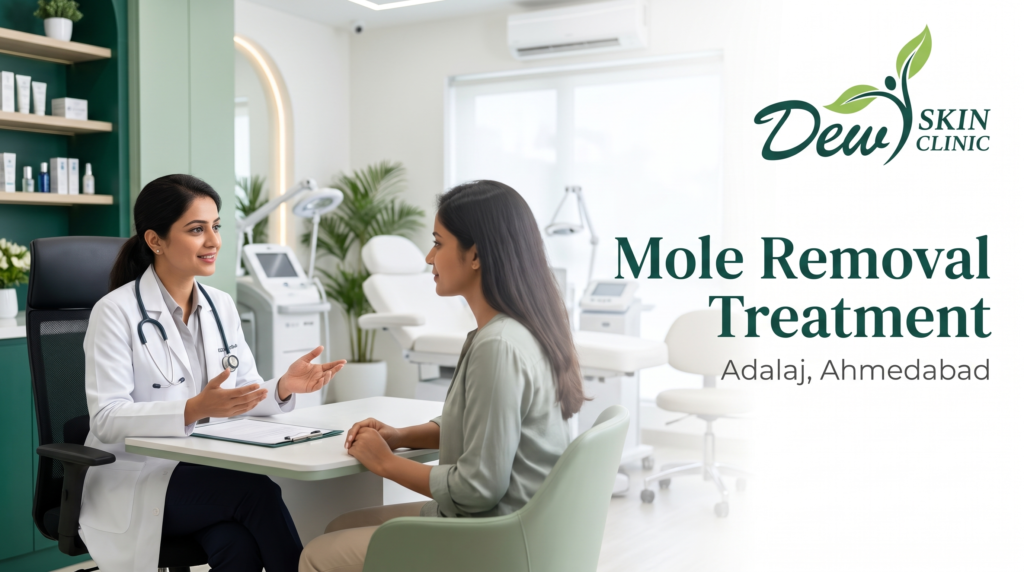
Mole Removal Treatment in Adalaj Ahmedabad: Safe, Doctor-Led Care at Dew Skin Clinic
If you have been looking for mole removal treatment in Adalaj Ahmedabad, you probably have a mole that bothers you. It may sit on your face and affect your confidence. It may catch on clothing, jewellery or a razor. Or it may have changed in colour or shape and made you worry. Whatever the reason, the most important step is the same: get the mole examined by a qualified dermatologist before anything is removed.
This guide explains how mole removal works, which methods are used, who needs a check-up first, what recovery looks like and how to choose the right mole removal clinic near Adalaj. It is written for residents of Adalaj, Shela, Bopal, Gandhinagar highway and nearby Ahmedabad areas who want clear, honest information before they decide.
What Is a Mole and Why Do Some People Want It Removed?
A mole, known medically as a melanocytic nevus, is a small skin growth made of pigment-producing cells called melanocytes. Most people have between 10 and 40 moles, and the majority are harmless. Moles can be flat or raised, light brown, dark brown, black, pink or skin-coloured. Some have hair growing from them.
People usually ask for mole removal in Adalaj for four reasons:
- Cosmetic concerns: a mole on the cheek, nose, lip, neck or forehead can feel very noticeable.
- Irritation: moles on the bra line, waistband, collar, underarm or beard area may rub, bleed or get nicked while shaving.
- Change in appearance: a mole that grows, darkens or becomes uneven should always be checked.
- Peace of mind: some people simply want a specialist opinion after noticing a new spot.
At Dew Skin Clinic, our approach is to look first and treat second. You can read a general overview on our mole removal treatment page, and this article goes deeper into what Adalaj patients can expect.
Types of Moles Commonly Treated by a Dermatologist
Not every dark spot is the same, and the correct method depends on the type of lesion. Common benign growths include:
- Congenital moles: present from birth, ranging from small to large.
- Acquired moles: appear during childhood, teenage years or adulthood.
- Raised (dermal) moles: dome-shaped, often skin-coloured or light brown, common on the face.
- Flat (junctional) moles: flat, evenly coloured spots.
- Dysplastic or atypical moles: irregular in shape or colour, needing closer monitoring.
- Look-alikes: seborrheic keratoses, skin tags, warts and birthmarks, which can resemble moles but are treated differently.
If your concern is actually a soft hanging growth, see our page on skin tag removal treatment. For rough, bumpy growths that may be viral, read about verruca and warts treatment. For patches present since birth, our birthmark removal treatment page is the right place to start.
When Should a Mole Be Checked Before Removal?
Removing a mole should never be a purely cosmetic decision made without examination. Dermatologists use the ABCDE rule to spot warning signs:
- A – Asymmetry: one half does not match the other.
- B – Border: edges are blurred, notched or irregular.
- C – Colour: several shades such as brown, black, red or blue in one mole.
- D – Diameter: larger than about 6 mm, roughly the size of a pencil eraser.
- E – Evolving: any change in size, shape, colour, height, or new itching, crusting or bleeding.
If any of these apply, please book a skin examination promptly. Early detection matters, and regular checks are one of the simplest forms of prevention. Our article on why regular skin cancer screenings are important explains who should be screened and how often.
A mole that looks suspicious is not simply burned or frozen off. It is examined closely and, when needed, removed in a way that allows it to be sent for laboratory testing.
Step One at Dew Skin Clinic: Examination and Dermoscopy
Every patient seeking mole removal treatment in Adalaj Ahmedabad begins with a consultation. The dermatologist reviews your medical history, asks how long the mole has been present, and checks for any recent change. Then the mole is examined with a dermatoscope, a handheld magnifying device that lets the doctor see pigment patterns beneath the surface.
This painless procedure, called dermoscopy, helps the doctor decide whether the mole is clearly benign, needs monitoring, or should be removed and tested. If testing is advised, a skin biopsy allows a pathologist to confirm the diagnosis. This step protects you, because the right treatment is chosen only after the right diagnosis.
You can meet our dermatologist, Dr. Vishal H. Shroff, and learn more about his approach on his profile page.
Mole Removal Methods Available for Adalaj Patients
There is no single best method for every mole. The doctor selects the technique based on the mole’s depth, size, colour, location and whether testing is required.
Radiofrequency and Electrocautery Mole Removal
Electrocautery uses a fine, controlled electrical current to remove small, raised, benign moles layer by layer. It offers precise control, minimal bleeding and a quick procedure time, often just minutes for a single mole. It is commonly used on the face and neck for small raised moles. Learn more about CO2 laser and electrocautery treatment at our clinic.
CO2 Laser Mole Removal
Laser mole removal vaporises the mole tissue in thin, controlled layers. Because the doctor can adjust depth carefully, laser is popular for facial moles where a smooth finish matters. Healing is typically clean, and the area is treated under local anaesthetic cream or injection so that the procedure is comfortable. A laser may not be the preferred choice if the doctor wants a tissue sample, so your examination result decides this.
Surgical Excision
When a mole is deeper, larger, or suspicious, the safest option may be to cut it out with a small margin and close the area with fine stitches. The removed tissue can then be sent for biopsy. This is a minor dermatosurgical procedure done in the clinic under local anaesthesia. See our dermato surgery page for details.
Shave Excision
For raised moles that are clearly benign, the doctor may shave the mole level with the surrounding skin using a fine blade. The base is then gently treated to control bleeding. This method is quick and often gives a flat, discreet result.
Cryotherapy
Cryotherapy uses extreme cold to destroy superficial growths. It is highly effective for warts, skin tags and certain surface lesions, but it is not usually the first choice for pigmented moles because the tissue cannot be tested afterwards. If your doctor feels it is appropriate for your lesion, you can read about cryotherapy treatment in Adalaj Ahmedabad for a closer look.
What Happens During the Procedure?
Most in-clinic mole removals are simple day-care procedures. A typical visit follows these steps:
- Consultation and dermoscopy: diagnosis and method selection.
- Consent and photographs: you understand the plan and expected results, and before photos are taken.
- Cleaning and numbing: the area is cleaned and a local anaesthetic is applied or injected.
- Removal: the chosen technique is performed. A single mole often takes 10 to 20 minutes.
- Dressing and instructions: a protective dressing is applied and aftercare is explained.
- Lab testing if advised: removed tissue is sent for analysis when needed.
You can usually return home immediately and resume light daily activities the same day. Your doctor will tell you exactly what to avoid in your case.
Is Mole Removal Painful?
Most patients describe a brief pinch during numbing and little to no pain during the procedure itself. Afterwards, mild tenderness or a stinging feeling for a day or two is common and can be managed as your doctor advises. Because the numbing is local, you stay awake and comfortable, with no need for general anaesthesia.
Recovery and Aftercare After Mole Removal
Good aftercare makes a real difference to how the skin heals and how faint the mark becomes. General guidance, which your doctor will adapt to you, includes:
- Keep the area clean and covered as advised during the first few days.
- Apply only the ointment or antibiotic cream prescribed.
- Do not pick, scratch or pull off the scab. It usually falls off on its own in about one to two weeks.
- Avoid swimming pools, heavy sweating and harsh scrubs until the skin closes.
- Protect the area from the sun using a broad-spectrum sunscreen once the skin has healed, since new skin is more prone to darkening.
- Attend the follow-up visit and share lab results with your doctor if testing was done.
Expect temporary redness or a pinkish patch for several weeks. This gradually fades, and in many cases the final mark is barely noticeable. If you notice increasing pain, pus, spreading redness or fever, contact the clinic right away.
Will Mole Removal Leave a Scar?
Any procedure that removes skin tissue can leave some mark, but the aim is always to keep it minimal. The final look depends on the mole’s depth, its site on the body, your skin type, how well you follow aftercare, and your natural healing tendency. People prone to thick or raised scars should tell their doctor in advance. If you already have marks from earlier procedures or acne, our acne scar treatment in Adalaj Ahmedabad page explains how texture and marks are improved.
Home Remedies and “Mole Removal Creams”: Why You Should Avoid Them
Online videos often promote garlic, apple cider vinegar, baking soda, castor oil or acid-based mole removal creams. Please avoid them. These products can cause chemical burns, infection, uneven pigmentation and permanent scarring. The bigger risk is that they can destroy the surface of a mole without removing it fully, hiding early warning signs and delaying a proper diagnosis. Cutting or tying off a mole at home is equally unsafe. Professional mole removal in a sterile clinic is far safer.
Who Is a Good Candidate for Mole Removal?
Most healthy adults are suitable candidates. The doctor will take extra care if you:
- have a history of keloids or thick scars,
- have a bleeding disorder or use blood-thinning medication,
- are pregnant or breastfeeding,
- have an active skin infection near the mole,
- have a personal or family history of melanoma.
Please share your full medical history during consultation. This helps the doctor choose the safest approach for you.
Mole Removal Cost in Adalaj Ahmedabad: What Affects the Price?
Many patients ask about the cost of mole removal in Adalaj. There is no fixed price that suits every patient, because the final cost depends on:
- the number of moles to be treated,
- the size, depth and location of each mole,
- the method used, such as electrocautery, laser or surgical excision,
- whether laboratory testing is needed,
- the number of follow-up visits.
The most reliable way to learn your cost is a short consultation. After examining the mole, the doctor can explain the recommended method and give a clear estimate with no surprises.
Why Choose Dew Skin Clinic for Mole Removal Near Adalaj?
Choosing a dermatologist for mole removal in Adalaj should come down to safety, diagnosis and trust. Here is what patients can expect at Dew Skin Clinic:
- Diagnosis first: every mole is examined, and dermoscopy is used where needed.
- Method matched to the mole: electrocautery, laser, shave or excision, chosen for your skin.
- Biopsy support: suspicious moles are removed so that they can be tested.
- Sterile, doctor-led procedures: done by a qualified dermatology team in a clinical setting.
- Clear communication: you hear the plan, the expected result and the aftercare before treatment starts.
- Complete skin care under one roof: from clinical dermatology to cosmetic care, with all dermatology services available together.
If you are comparing options, our page on a trusted dermatology clinic in Adalaj Ahmedabad explains how we care for patients from the Adalaj area.
Other Skin Concerns We Treat for Adalaj Residents
Many patients who come for mole removal also have other skin or hair concerns. Dew Skin Clinic offers local care for:
- Melasma treatment in Adalaj for stubborn facial pigmentation
- Acne and pimple treatment in Adalaj for active breakouts
- Hair loss treatment in Adalaj for thinning and shedding
- Anti-aging skin treatment in Adalaj for fine lines and dull skin
- Facial hair removal laser in Adalaj for smooth, long-lasting results
If you live closer to another part of the city, we also offer mole removal treatment in Chandkheda Ahmedabad.
Frequently Asked Questions About Mole Removal in Adalaj
Is mole removal safe?
Yes, when performed by a qualified dermatologist after proper examination, mole removal is a safe and routine procedure. Safety depends on correct diagnosis, the right technique and sterile conditions.
How long does mole removal take?
A single small mole usually takes 10 to 20 minutes, including numbing. Multiple or larger moles may take longer.
Will I need stitches?
Stitches are generally needed only for surgical excision. Electrocautery, laser and shave methods usually heal without them.
How long does healing take?
The surface typically heals in one to two weeks. Redness may take a few weeks to fade, and full skin maturation can take a few months.
Can all moles be removed in a single visit?
Many benign moles can be treated in one session. The number you can have treated at once depends on their size and location, and your doctor will advise you.
Do I need a biopsy?
Not always. If the mole looks clearly benign on dermoscopy, a biopsy may not be needed. If it looks suspicious or has changed, testing is strongly advised.
Is mole removal permanent?
Removed moles usually do not return, but a few can recur if some pigment cells remain. Any regrowth should be reviewed by your doctor.
Book Your Mole Removal Consultation in Adalaj Ahmedabad
A mole that bothers you or worries you deserves a proper evaluation, not guesswork. Whether you want a cosmetic cleanup or a reassuring second opinion, a short consultation with a dermatologist will give you clear answers.
To get started, visit our book appointment page or reach us through the contact us page. You can also review the frequently asked questions on our site for more information.
Dew Skin Clinic brings careful diagnosis and modern techniques to patients seeking safe mole removal treatment in Adalaj Ahmedabad. Book your visit today and take the first step toward clear, confident skin.
Disclaimer: This article is for general education and does not replace a medical consultation. Results vary from person to person. Always seek advice from a qualified dermatologist about your skin.