
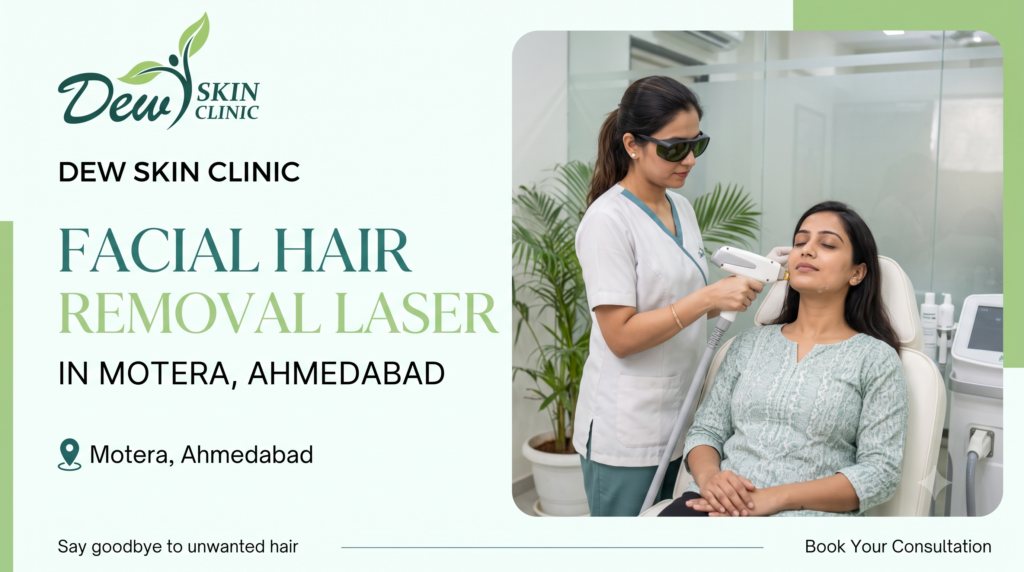
If you are tired of shaving, threading, and waxing every few weeks just to keep your face smooth, you are not alone. Unwanted hair on the upper lip, chin, cheeks, and jawline is one of the most common reasons people walk into a dermatology clinic. It affects confidence, daily routines, and even how comfortable you feel in photos. The good news is that facial hair removal laser in Motera, Ahmedabad has become a safe, structured, and long-lasting alternative to temporary methods, provided it is done by a qualified dermatologist on the right device.
At Dew Skin Clinic, we treat unwanted facial hair as a medical-aesthetic concern, not just a beauty one. This guide explains how laser hair removal for the face works, who it suits, what a session feels like, how many sittings you need, how to prepare, and what to expect afterwards. If you live in Motera, Sabarmati, Chandkheda, or Adalaj and you have been searching for laser hair removal near me, this article will help you decide with confidence.
What Is Facial Laser Hair Removal?
Facial laser hair removal is a procedure in which a focused beam of light energy is directed at the hair follicles on your face. The pigment (melanin) in each hair absorbs that energy and turns it into heat, which damages the follicle enough to slow down or stop future growth. Because the laser targets the follicle, the surrounding skin is largely spared when the settings are matched correctly to your skin tone and hair type.
It is more accurate to call the result laser hair reduction than “permanent removal”. Most people see a significant, long-term drop in hair density and thickness, and the hair that does return tends to be finer and lighter. A few maintenance sessions may be needed later, especially when hormones are involved. Our dedicated facial hair removal treatment page gives the clinical overview, while our broader laser hair reduction treatment page explains the technology used for other body areas.
Why Does Unwanted Facial Hair Grow?
Understanding the cause helps you set realistic expectations. The most common reasons include:
- Hormonal imbalance: Higher androgen levels, as seen in PCOS or PCOD, can trigger coarse, dark hair on the chin, jawline, and upper lip.
- Genetics: Darker, denser facial hair simply runs in many families.
- Life stages: Puberty, pregnancy, and menopause all shift hormones and can change hair growth patterns.
- Medicines: Some steroids and hormonal medicines can increase facial hair.
- Repeated plucking or shaving: These do not change the root, but they often cause ingrown hairs, irritation, and dark marks.
If your facial hair appeared suddenly, is spreading quickly, or comes with irregular periods, acne, or hair thinning, we recommend a dermatologist consultation before starting laser. Treating the underlying cause alongside the laser gives the best long-term outcome. Many patients who visit us for facial hair also ask about hair loss treatment in Motera, because hormonal changes can affect both.
How Does Laser Remove Facial Hair?
Hair grows in cycles: an active growth phase, a short transition phase, and a resting phase. Laser works best on hairs in the active growth phase, which is why one session cannot clear everything. Each session catches a fresh batch of follicles, and repeating sessions at planned intervals gradually covers them all.
Diode laser technology is widely preferred for Indian skin tones. Its wavelength reaches deep into the follicle while being comparatively gentle on surface pigment, and contact cooling protects the skin during pulses. You can read about the device category on our Milesman diode laser page. Your dermatologist adjusts the energy level, pulse duration, and spot size according to your skin tone, hair thickness, and the area being treated, which is why settings are never one-size-fits-all.
Laser vs Waxing, Threading, Shaving, and Creams
Most people try several temporary methods before they consider laser. Here is how they compare for the face:
| Method | How long it lasts | Common problems | Long-term view |
|---|---|---|---|
| Shaving | 1 to 3 days | Stubble, cuts, ingrown hairs | Endless repetition |
| Threading | 2 to 4 weeks | Redness, sensitivity, breakouts | Ongoing effort |
| Waxing | 3 to 4 weeks | Pain, irritation, pigmentation marks | Ongoing cost |
| Hair removal creams | 1 to 2 weeks | Allergy, chemical burns | Not ideal for sensitive facial skin |
| Laser hair reduction | Long-term reduction after a full course | Mild, temporary redness | Higher upfront cost, fewer repeat sessions |
The real advantage of laser is cumulative. Each session weakens the follicles further, so you spend less time and money on upkeep as the course progresses. It also helps with ingrown hairs and the dark, rough patches that come from constant shaving or waxing.
Is Laser Suitable for Your Skin and Hair Type?
Laser hair removal works best on dark, coarse hair because melanin is what the laser “sees”. That makes most Indian patients good candidates. However, a few points matter:
- Skin tone: Medium-brown to deeper skin tones can be treated safely with the right wavelength, cooling, and conservative settings, which is why a doctor-led assessment is essential.
- Hair colour: White, grey, red, and very light blonde hair has little melanin and may respond poorly.
- Tanning: Fresh sun exposure raises the risk of burns and pigmentation, so treatment is usually postponed.
- Medical history: Pregnancy, active skin infections, certain medicines (including isotretinoin and photosensitising drugs), and a tendency toward keloids need to be discussed first.
- Pigmentation concerns: If you have melasma or uneven tone, laser must be planned carefully. Our pigmentation and melasma treatment team, including our melasma treatment in Motera service, can sequence both treatments safely.
A patch test on a small area is usually done first to check how your skin reacts.
Who Should Consider Facial Laser Hair Removal in Motera?
Residents of Motera, Sabarmati, Chandkheda, and Adalaj often tell us the same thing: they want a lasting fix that fits around work, college, and family schedules. Laser suits you if you shave or thread more than once a week, get ingrown hairs or razor bumps, notice dark shadows on the upper lip or chin, or have coarse hair linked to PCOS. Because sessions are short and there is no downtime, most patients visit during a lunch break or after work and carry on with their day.
Which Facial Areas Can Be Treated?
Laser can treat almost every area of the face and neck:
- Upper lip: The most requested area, quick and ideal for first-timers.
- Chin and jawline: Often linked to hormonal hair, and usually coarse and stubborn.
- Cheeks and sideburns: Fine-to-medium hair that can look like a shadow on camera.
- Between the eyebrows and forehead: Careful, precise treatment with eye protection.
- Neck: Common in people with PCOS and in men who struggle with shaving bumps.
- Full face: A complete course for a uniformly smooth finish.
Men can also benefit, particularly for beard shaping and ingrown beard hairs.
What Happens During a Facial Laser Session at Dew Skin Clinic?
A typical visit is simple and unrushed. You can expect these steps:
- Consultation and skin analysis: The dermatologist reviews your hair pattern, skin tone, medical history, and medicines, and explains a realistic plan. You can learn more about our lead doctor on the Dr. Vishal H. Shroff page.
- Patch test: A small test pulse confirms the right settings for you.
- Preparation: The area is cleaned and trimmed or shaved so the energy reaches the follicle rather than burning surface hair.
- Protection: You wear protective eyewear, and a cooling method is used to keep the skin comfortable.
- Laser pulses: The handpiece is moved across the area. Most people describe a quick snapping or warm sensation, which is tolerable for most.
- Soothing and sun protection: A calming gel and sunscreen are applied, and aftercare instructions are given.
An upper lip session can take only a few minutes, while a full face typically takes around twenty to thirty minutes. You can return to normal activities right away. Ready to start? You can book an appointment online.
How Many Sessions Will You Need?
Because only actively growing hairs respond at any one time, facial laser is always a course, not a single sitting. Most people need around six to eight sessions, spaced roughly four to six weeks apart for the face. You may notice shedding and slower regrowth after the first or second session, and clear reduction by the third or fourth.
Hormonal hair, such as PCOS-related chin and jawline growth, may need more sessions and occasional maintenance because new follicles can become active over time. Brides-to-be should start early, ideally several months before the wedding, so the course is complete and the skin has settled. If you are planning for the big day, ask about combining sessions with our bridal skin treatments.
Before and After Care for the Best Results
Before your session
- Shave the area gently 12 to 24 hours before. Avoid waxing, threading, and plucking for three to four weeks, since the root must be present for the laser to work.
- Avoid sun exposure and tanning for at least two weeks.
- Pause strong skin actives such as retinoids and exfoliating acids if your doctor advises it.
- Tell your dermatologist about every medicine and skin cream you use.
After your session
- Expect mild redness or small bumps around follicles for a few hours to a day.
- Avoid hot showers, steam, saunas, and heavy workouts for 24 hours.
- Apply a gentle moisturiser and a broad-spectrum sunscreen of SPF 30 or higher every day.
- Do not pick, scratch, or wax. Shave only if needed between sessions.
- Hold off on chemical peels, scrubs, and strong facials until your doctor gives the go-ahead.
- Do not worry if hair seems to “grow” over the next one to three weeks. This is usually shedding of treated hair.
Is Facial Laser Hair Removal Safe? Side Effects to Know
When performed by a trained dermatologist with the correct device and settings, facial laser hair reduction is considered safe. Temporary redness, mild swelling, tingling, and small bumps are the most common effects. Less commonly, improper settings or poor aftercare can cause blisters, burns, or changes in skin colour (darker or lighter patches). Rarely, fine hair can become thicker or appear in new areas after laser, which is why monitoring matters.
This is exactly why we advise against treatment at unregulated salons or by untrained operators. A doctor can match the laser to your skin, manage complications, and treat any underlying condition. If you have specific worries, our FAQs page answers many common questions.
What Affects the Cost of Facial Hair Removal Laser in Motera?
There is no single fixed price, because the cost depends on several factors:
- Area size: An upper lip costs less than a full face and neck.
- Hair density and thickness: Dense, hormonal hair may need more sessions.
- Number of sessions: Packages usually work out more economical than single sittings.
- Device and clinic standards: Doctor-led care, hygiene, and quality equipment matter.
- Add-on care: Treatment of pigmentation or hormonal concerns may be included in your plan.
The best way to get an accurate figure is a short consultation. You can contact Dew Skin Clinic to ask about current packages, or browse our full dermatology services to see what else we offer.
Why Choose Dew Skin Clinic for Facial Hair Removal Laser in Motera, Ahmedabad?
Choosing the right clinic matters more than choosing the right machine. Here is what patients in Motera and nearby areas look for, and what we focus on:
- Doctor-led assessment: Every plan starts with a consultation, not a sales pitch.
- Skin-type-based settings: Energy is tailored to your tone, hair, and area, with a patch test where needed.
- Complete dermatology support: If acne, scars, pigmentation, or ageing concerns are present, we can plan them together. Our acne and pimple treatment in Motera and anti-aging skin treatment in Motera pages show how we approach those concerns.
- Honest guidance: We explain what laser can and cannot do, including the need for maintenance in hormonal cases.
- Patient feedback: You can read real experiences on our testimonials page.
Frequently Asked Questions
Is facial laser hair removal in Motera safe for women?
Yes, when it is performed by a qualified dermatologist using a suitable laser and correct settings for your skin tone. A consultation and patch test help reduce risks.
Is facial laser hair removal painful?
Most people feel a brief snapping or warm sensation, and the upper lip can feel slightly more sensitive. Cooling reduces discomfort, and sessions are short.
Is facial laser hair removal permanent?
Laser provides long-term hair reduction rather than guaranteed permanent removal. After a full course, hair is usually much finer and sparser. Hormonal conditions like PCOS may need occasional maintenance sessions.
Can PCOS patients get laser hair removal on the face?
Yes. Many people with PCOS choose laser for chin and jawline hair. Because hormones keep stimulating hair, it is best to manage the underlying condition with your doctor alongside laser sessions.
How soon will I see results?
You may notice slower regrowth and some shedding after the first sessions, with clearer reduction by the third or fourth. Full results come after completing the planned course.
Can men get facial laser hair removal?
Yes. Men often use laser for beard line shaping, neck hair, and ingrown hair problems caused by regular shaving.
Final Thoughts: Smooth Skin Without the Weekly Routine
If you are ready to stop the constant cycle of shaving, threading, and waxing, a doctor-led course of facial laser hair reduction is a practical, evidence-based way forward. The key is a proper assessment, the right device, realistic expectations, and consistent aftercare.
Dew Skin Clinic offers personalised facial hair removal laser in Motera, Ahmedabad, backed by full dermatology expertise. Book your consultation today and take the first step toward smoother, more confident skin.
Disclaimer: This article is for general education and is not a substitute for medical advice. Results vary from person to person. Please consult a qualified dermatologist before starting any treatment.