If you live in South Bopal and you’re dealing with a stubborn skin tag, a wart that won’t go away, or a rough patch of sun-damaged skin, you’ve probably already searched for “cryotherapy treatment near me” more than once. South Bopal has grown into one of Ahmedabad’s most sought-after residential pockets, and along with that growth has come a real demand for advanced, minimally invasive dermatology — the kind that doesn’t require a full day off work or a scary surgical procedure. Cryotherapy treatment in South Bopal, Ahmedabad is exactly that: a quick, well-established, freezing-based procedure that dermatologists have relied on for decades to safely remove unwanted skin growths and treat a range of benign skin conditions.
At Dew Skin Clinic, we’ve seen a steady rise in patients from South Bopal, Bopal, and the surrounding SP Ring Road belt asking about cryotherapy — not because it’s a trend, but because it genuinely works, heals fast, and leaves minimal scarring when it’s done correctly by a trained dermatologist. This guide walks you through exactly what cryotherapy treatment involves, which conditions it treats, what to expect during and after your session, and why choosing the right clinic in South Bopal, Ahmedabad matters more than most people realize.
What Is Cryotherapy Treatment?
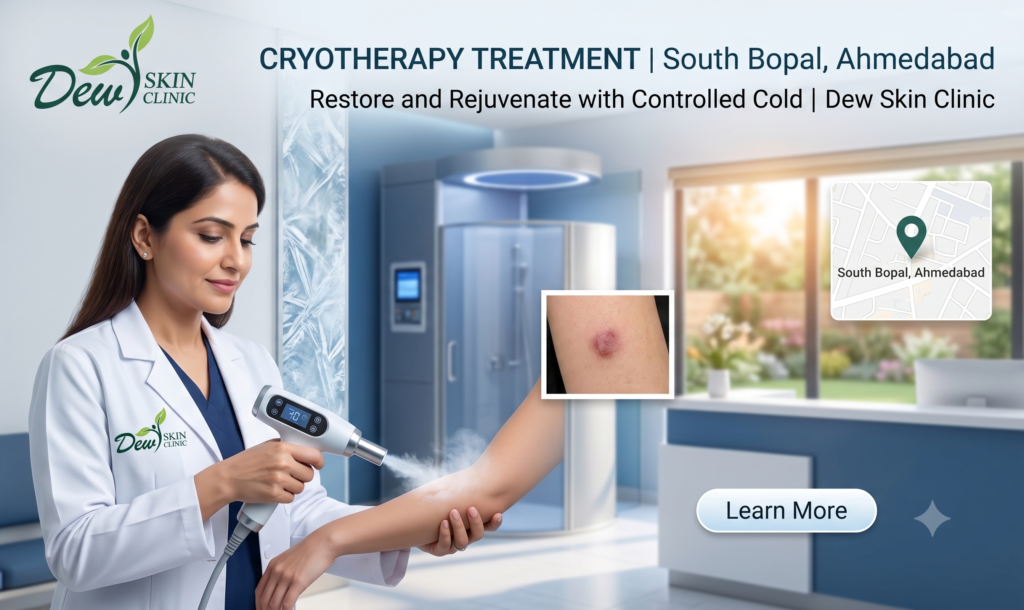
Cryotherapy, sometimes called cryosurgery, is a dermatological procedure that uses extreme cold — typically liquid nitrogen — to destroy abnormal or unwanted skin tissue. The word itself comes from the Greek “cryo,” meaning cold, and “therapy,” meaning treatment. In simple terms, a dermatologist applies liquid nitrogen directly onto the target area, usually with a fine spray device or a cotton-tipped applicator. The extreme cold freezes the cells within the lesion, causing them to die off over the following days. The treated tissue typically forms a blister, dries out, and eventually flakes away, revealing healthier skin underneath.
Cryotherapy treatment has been used in dermatology for decades because it’s precise, doesn’t require anesthesia in most cases, and rarely leaves significant scarring when the procedure is performed by an experienced hand. It’s this precision and safety profile that has made cryotherapy treatment in South Bopal, Ahmedabad an increasingly requested procedure among patients who want fast, effective results without the downtime associated with surgical excision.
Unlike some cosmetic procedures that promise vague, hard-to-measure results, cryotherapy has a clear, visible before-and-after outcome. The lesion is there, and then — after the healing period — it isn’t. That directness is a big part of why so many dermatologists, including our team at Dew Skin Clinic, consider it one of the most reliable tools for treating benign skin growths.
How Does Cryotherapy Work on the Skin?
When liquid nitrogen (which reaches temperatures of around -196°C) is applied to skin tissue, it causes rapid freezing at the cellular level. Ice crystals form inside and around the targeted cells, which disrupts the cell membranes and damages the cellular structure beyond repair. As the area then thaws, blood flow to the region is affected, which further starves the damaged tissue of nutrients and oxygen.
This freeze-thaw cycle is often repeated once or twice during a single session, depending on the size, depth, and type of the lesion being treated. Over the next several days, the treated skin will typically:
- Turn white or slightly red immediately after treatment
- Form a small blister within a few hours to a day
- Gradually darken and scab over
- Flake or fall off naturally within one to three weeks, revealing new skin
For most minor lesions, a single cryotherapy session is enough. Thicker or larger growths, such as some warts, may require two to six sessions spaced three to four weeks apart for complete resolution. Your dermatologist at Dew Skin Clinic will assess the lesion at your first visit and give you a realistic sense of how many sessions you’re likely to need.
Conditions Cryotherapy Treatment Can Address
One of the biggest reasons cryotherapy treatment in South Bopal, Ahmedabad has become so popular is its versatility. It isn’t limited to one type of skin concern — dermatologists use it across a fairly wide range of benign and precancerous conditions, including:
Skin tags: Small, soft growths that commonly appear on the neck, underarms, and eyelids. Cryotherapy is one of the fastest and least invasive ways to remove them.
Warts (verrucae): Caused by the human papillomavirus (HPV), warts respond well to freezing because the resulting blister and immune response help clear the underlying viral infection, not just the visible growth.
Seborrheic keratoses: Benign, wart-like growths that tend to appear with age, often on the chest, back, and face.
Moles (select cases): Certain benign, superficial moles can be treated with cryotherapy after proper dermatological evaluation.
Actinic keratosis: Rough, scaly patches caused by sun damage that are considered precancerous and are commonly treated preventively with cryotherapy.
Solar lentigines (age spots/sun spots): Common in Ahmedabad’s high-UV climate, these pigmented spots often respond well to targeted freezing.
Keloid and hypertrophic scars: In combination with other treatments, cryotherapy can help flatten and soften raised scar tissue.
Molluscum contagiosum: A viral skin infection that causes small, raised bumps, frequently seen in both children and adults.
Because South Bopal’s climate is hot and sun-exposed for a large part of the year, our dermatologists frequently see patients present with sun-related lesions like actinic keratosis and solar lentigines alongside the more common skin tags and warts. If you’re unsure whether your specific skin concern is a good candidate for cryotherapy, an in-person evaluation is always the safest first step — not every lesion is appropriate for freezing, and a proper diagnosis rules out anything that needs a different kind of care, such as our dermato-surgery services for more complex removals.
Why South Bopal Residents Are Choosing Cryotherapy Over Other Options
South Bopal sits at a convenient crossroads for residents of Bopal, Ghuma, South Bopal itself, and even parts of the SG Highway corridor. As the area has become more residential and family-oriented, the demand for accessible, high-quality dermatology care close to home has grown right along with it. A few reasons cryotherapy specifically has become a preferred option locally:
It’s fast. Most cryotherapy sessions take just a few minutes per lesion, which matters for working professionals and parents in South Bopal who don’t want to lose half a day to a clinic visit.
It avoids surgical cutting. For patients who are apprehensive about scalpel-based procedures, freezing offers a needle-free, blade-free alternative for many common lesions.
Minimal downtime. Unlike surgical excision, which may require stitches and a longer recovery, cryotherapy generally allows patients to return to normal activities the same day.
Lower scarring risk. When performed correctly, cryotherapy has a strong track record for cosmetically favorable healing, which is a major consideration for visible areas like the face and neck.
Cost-effectiveness. Compared to laser-based removal for similar lesions, cryotherapy is often a more budget-friendly option, especially when only one or two small lesions need treatment.
That said, “fast and simple” doesn’t mean it should be treated casually. The depth of freezing, the duration of each freeze-thaw cycle, and the technique used all directly affect both the results and the risk of side effects like hypopigmentation (lightening of the skin) or scarring. This is exactly why the choice of clinic and dermatologist matters as much as the treatment itself.
What to Expect During Your Cryotherapy Session at Dew Skin Clinic
If you’re booking your first cryotherapy treatment in South Bopal, Ahmedabad, here’s a realistic walkthrough of what the appointment typically looks like at our clinic:
- Consultation and diagnosis. Your dermatologist examines the lesion, confirms it’s a suitable candidate for cryotherapy, and rules out anything that would need a biopsy or alternative treatment. You can read more about how we approach initial evaluations on our skin biopsy page if a lesion needs further investigation before treatment.
- Preparation. The area is cleaned. In most cases, no numbing or anesthesia is required, since the sensation is brief, though some sensitive areas may be prepped differently.
- Application of liquid nitrogen. Using a precise spray device or applicator, the dermatologist freezes the lesion for a controlled duration — often 10 to 30 seconds per freeze cycle, repeated once or twice depending on the lesion.
- Immediate aftercare instructions. You’ll be told what to expect over the coming hours and days, along with how to care for the area to support clean healing.
- Follow-up planning. For lesions that need multiple sessions, your next appointment is typically scheduled three to four weeks out to allow full healing between treatments.
Most patients describe the sensation as a sharp, cold sting that lasts only as long as the freezing itself — generally tolerable without any need for local anesthesia. Mild discomfort or a dull ache may follow for a short period afterward, similar to a minor burn sensation.
Aftercare: How to Care for Your Skin Post-Cryotherapy
Proper aftercare plays a big role in how well your skin heals and how minimal the scarring ends up being. After your cryotherapy treatment, we recommend:
- Keeping the treated area clean and dry for the first 24 hours
- Avoiding picking or popping any blister that forms — let it heal naturally
- Applying a gentle antiseptic ointment if advised by your dermatologist
- Protecting the area from direct sun exposure, especially important given Ahmedabad’s intense UV levels
- Avoiding harsh scrubs, exfoliants, or active skincare ingredients on the treated area until it’s fully healed
- Wearing a broad-spectrum sunscreen once the skin has closed, to prevent post-inflammatory pigmentation
Most minor lesions heal fully within one to three weeks. If you notice unusual swelling, pus, spreading redness, or a fever, contact your clinic immediately, as these could indicate an infection requiring prompt attention.
Is Cryotherapy Treatment Safe? Understanding the Risks
Cryotherapy has an excellent overall safety profile when performed by a qualified dermatologist, but like any medical procedure, it isn’t entirely risk-free. Possible side effects include:
- Temporary redness and swelling
- Blistering (an expected and normal part of the healing process)
- Mild to moderate pain during and briefly after treatment
- Hypopigmentation or hyperpigmentation (lightening or darkening of the treated skin, which is more common in darker skin tones)
- Rarely, infection if aftercare instructions aren’t followed
- Very rarely, scarring, especially with overly aggressive freezing
This is precisely why cryotherapy should always be performed by a trained dermatologist rather than at a generic beauty salon or with an over-the-counter freezing kit. Pigmentation changes, in particular, are a real consideration for many South Bopal patients, since Indian skin types are more prone to post-inflammatory pigmentation than fairer skin types. An experienced dermatologist calibrates the freeze duration and depth specifically with this in mind, which significantly reduces the risk. If pigmentation concerns are already something you’re managing, it may be worth also exploring our dedicated pigmentation & melasma treatment options alongside your cryotherapy plan.
Cryotherapy vs. Other Skin Lesion Removal Methods
Patients often ask how cryotherapy compares to other removal techniques available at dermatology clinics. Here’s a quick breakdown:
Cryotherapy vs. surgical excision: Excision is generally reserved for larger, deeper, or more complex lesions, and it typically involves stitches and a longer recovery. Cryotherapy is faster and better suited to smaller, superficial lesions.
Cryotherapy vs. laser removal: Laser treatments can offer more precision for certain pigmented or vascular lesions, but they’re often more expensive and may require specialized equipment. Cryotherapy remains a cost-effective, widely accessible first-line option for many benign growths.
Cryotherapy vs. CO2 laser/electrocautery: For some raised lesions, CO2 laser and electrocautery treatment may be recommended instead, particularly when a lesion’s size or location makes freezing less suitable. Your dermatologist will guide you toward whichever method offers the best combination of safety and outcome for your specific lesion.
The right choice always comes down to the type, size, depth, and location of the lesion — which is exactly why a proper in-clinic evaluation matters more than trying to self-diagnose based on photos or general online advice.
Why Choose Dew Skin Clinic for Cryotherapy Treatment in South Bopal, Ahmedabad
Dew Skin Clinic has built its reputation across Ahmedabad — including South Bopal, Satellite, Prahlad Nagar, Thaltej, and Science City Road — on a simple principle: dermatology should be accurate, evidence-based, and delivered by qualified specialists, not rushed or templated. When you choose us for cryotherapy treatment, you’re getting:
- Board-certified dermatologists with hands-on experience in cryosurgery and lesion management
- Accurate diagnosis before treatment, so you’re never freezing a lesion that actually needs a biopsy or a different approach
- Calibrated freeze-thaw technique, minimizing the risk of scarring and pigmentation changes common with over-aggressive freezing
- Clear aftercare guidance, so healing stays on track and complications are caught early
- A comfortable, hygienic clinical environment, designed around patient comfort from consultation to follow-up
- Transparent, upfront treatment planning, so you know exactly how many sessions to expect and why
We also understand that many patients booking cryotherapy treatment in South Bopal, Ahmedabad are dealing with more than one skin concern at a time. That’s why our dermatologists often build a broader treatment plan that might combine cryotherapy with services like our hair loss & hair thinning treatment or acne scars programs, depending on what you’re looking to address. You can browse our complete range of services on our services page to see how we approach dermatology holistically rather than as a single isolated procedure.
How Much Does Cryotherapy Treatment Cost in South Bopal, Ahmedabad?
Cryotherapy pricing varies depending on the size, number, and type of lesions being treated, as well as how many sessions are required for full resolution. Small, single lesions like an individual skin tag or wart are generally on the lower end of the pricing scale, while multiple lesions or larger areas will naturally cost more. Rather than quoting a flat, one-size-fits-all number that may not reflect your actual case, we recommend booking a consultation so your dermatologist can examine your specific lesion(s) and give you an accurate, transparent quote along with an expected number of sessions. You can check current pricing guidance and book directly through our book appointment page.
Frequently Asked Questions About Cryotherapy Treatment in South Bopal, Ahmedabad
Is cryotherapy painful? Most patients describe a brief, sharp cold or stinging sensation during the freezing itself, followed by mild discomfort for a short period afterward. It’s generally well-tolerated without anesthesia.
How many sessions will I need? It depends on the lesion. Many skin tags and small warts clear in a single session, while thicker or larger lesions may need two to six sessions spaced three to four weeks apart.
Will cryotherapy leave a scar? When performed correctly by an experienced dermatologist, scarring is uncommon. Risk increases with overly aggressive freezing or lesions in higher-risk areas, which is why professional technique matters.
Can cryotherapy treat dark spots or pigmentation from the sun? Yes, solar lentigines (sun spots) are a common indication for cryotherapy, though your dermatologist will assess whether freezing or another pigmentation-focused treatment is the better fit for your skin.
Is cryotherapy safe for Indian skin tones? Yes, when performed with appropriate technique and calibrated freeze duration. Indian skin types are more prone to temporary pigmentation changes, so it’s especially important to have the procedure done by a qualified dermatologist who accounts for this.
How soon can I return to normal activities after treatment? Most patients resume regular activities the same day. You’ll just need to follow aftercare instructions and avoid sun exposure or irritation to the treated area during healing.
Is cryotherapy covered by insurance? Coverage depends on whether the procedure is deemed medically necessary (such as for precancerous lesions) versus purely cosmetic. Our team can help clarify this during your consultation.
Do I need a biopsy before cryotherapy? Not always, but if there’s any uncertainty about a lesion’s nature, your dermatologist may recommend a biopsy first to rule out anything that needs a different treatment approach.
Book Your Cryotherapy Consultation in South Bopal, Ahmedabad Today
If you’ve been putting off dealing with a skin tag, wart, or sun spot because you weren’t sure where to go, cryotherapy treatment in South Bopal, Ahmedabad doesn’t have to be complicated or intimidating. At Dew Skin Clinic, our dermatologists combine accurate diagnosis, calibrated technique, and clear aftercare support to make the entire process as smooth as possible — from your first consultation to your final follow-up. Learn more about our team and approach on our about us page, browse real patient experiences on our testimonials page, or reach out directly through our contact us page to get your questions answered before booking. Your skin doesn’t have to wait — schedule your cryotherapy consultation with Dew Skin Clinic today.